- Your cart is empty
- Continue Shopping

Waklert Tolerance and Long-Term Use: What the Evidence Says
- Armodafinil
- Posted on
-
by ModvigilAUS Medical Editorial Team
- 1 comment

Medical Disclaimer
This article provides general educational information and does not replace advice from a qualified healthcare professional. It should not be used to self-prescribe armodafinil or independently alter prescribed treatment.
Can regular Waklert use lead to tolerance, making the medicine feel less effective over time? Waklert tolerance is possible, but it is not inevitable. Long-term studies of armodafinil have found sustained wakefulness benefits among many patients. However, postmarketing reports also document cases of tolerance.
Waklert contains armodafinil, a prescription wakefulness-promoting medicine. Most published long-term clinical evidence involves armodafinil studied in other formulations, including Nuvigil, rather than Waklert specifically.
Understanding changes in effectiveness requires distinguishing genuine pharmacological tolerance from insufficient sleep, changes in underlying medical conditions and individual treatment responses.
It is equally important to recognise that tolerance, physical dependence, withdrawal and addiction are different medical concepts.
What Is Waklert Tolerance?
Pharmacological tolerance occurs when repeated exposure to a medicine produces a reduced response.
For Waklert, tolerance would mean that the same exposure to its active ingredient, armodafinil, produces less wakefulness-related benefit than previously experienced.
However, noticing reduced effectiveness does not automatically establish pharmacological tolerance.
Someone receiving treatment for excessive daytime sleepiness may experience worsening fatigue because of inadequate sleep, changes in their underlying disorder or another medical condition.
Consequently, the medicine may seem less effective even when pharmacological sensitivity has not changed.
This distinction matters because tolerance describes a physiological adaptation, whereas perceived effectiveness reflects several interacting factors.
Clinical assessment may involve reviewing symptom patterns, sleep quality, treatment adherence and other explanations before attributing reduced benefit to tolerance.
Waklert tolerance should therefore not be confused with ordinary fluctuations in alertness.
Waklert tolerance is a clinical question about changes in response, not simply how alert someone feels on a particular day.
Can You Develop Tolerance to Waklert?
Tolerance to armodafinil can occur, although available evidence does not establish how frequently it develops during appropriately prescribed treatment.
The US Nuvigil prescribing information reports multiple postmarketing cases of tolerance.
Postmarketing reports describe events identified after a medicine becomes available for clinical use.
These reports demonstrate that tolerance has been observed. However, they cannot reliably establish its frequency, predict individual risk or determine a typical time to onset.
Long-term clinical studies provide another perspective.
Research involving patients with narcolepsy, treated obstructive sleep apnoea and shift work disorder has documented sustained improvements in wakefulness during extended armodafinil treatment.
These findings suggest that meaningful benefits can persist over time. Nevertheless, continued improvement across a study population does not exclude tolerance in individual participants.
Importantly, Waklert and Nuvigil are separately branded products containing the same active ingredient. Clinical results for Nuvigil or other armodafinil formulations do not automatically establish Waklert-specific bioequivalence, effectiveness or safety.
Overall, the evidence supports both the possibility of armodafinil tolerance and the persistence of clinical benefits in many studied patients.
Neither outcome is guaranteed for an individual.
For more context about different armodafinil brands, see our Waklert vs Artvigil comparison. Brand comparisons do not establish equivalent clinical outcomes.
What Does Research Say About Long-Term Armodafinil Use?
Evidence From Clinical Studies
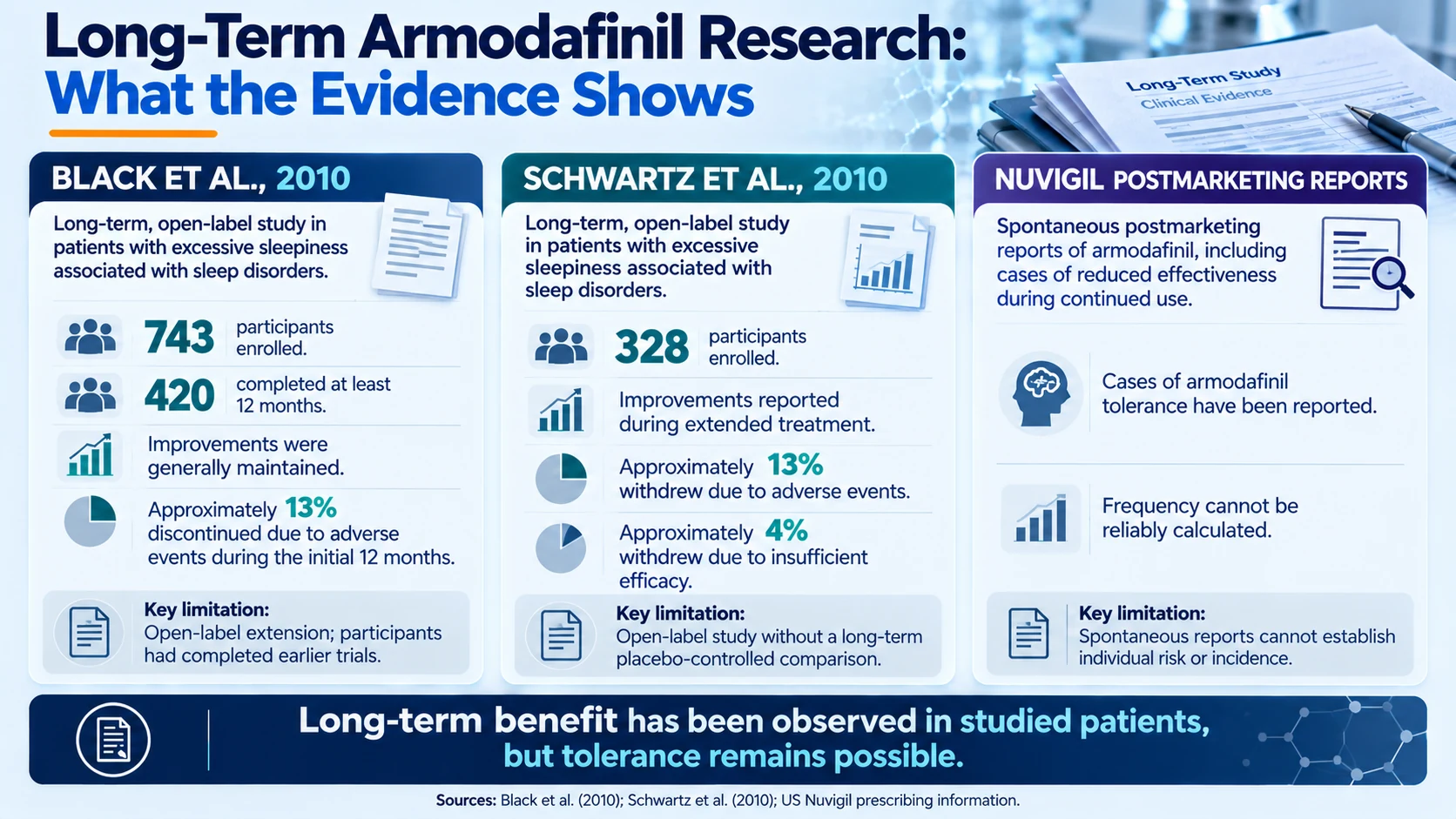
Two peer-reviewed studies published in the Journal of Clinical Sleep Medicine in 2010 provide useful evidence about prolonged armodafinil treatment.
Black et al., 2010
Black and colleagues studied adults who had completed earlier 12-week clinical trials.
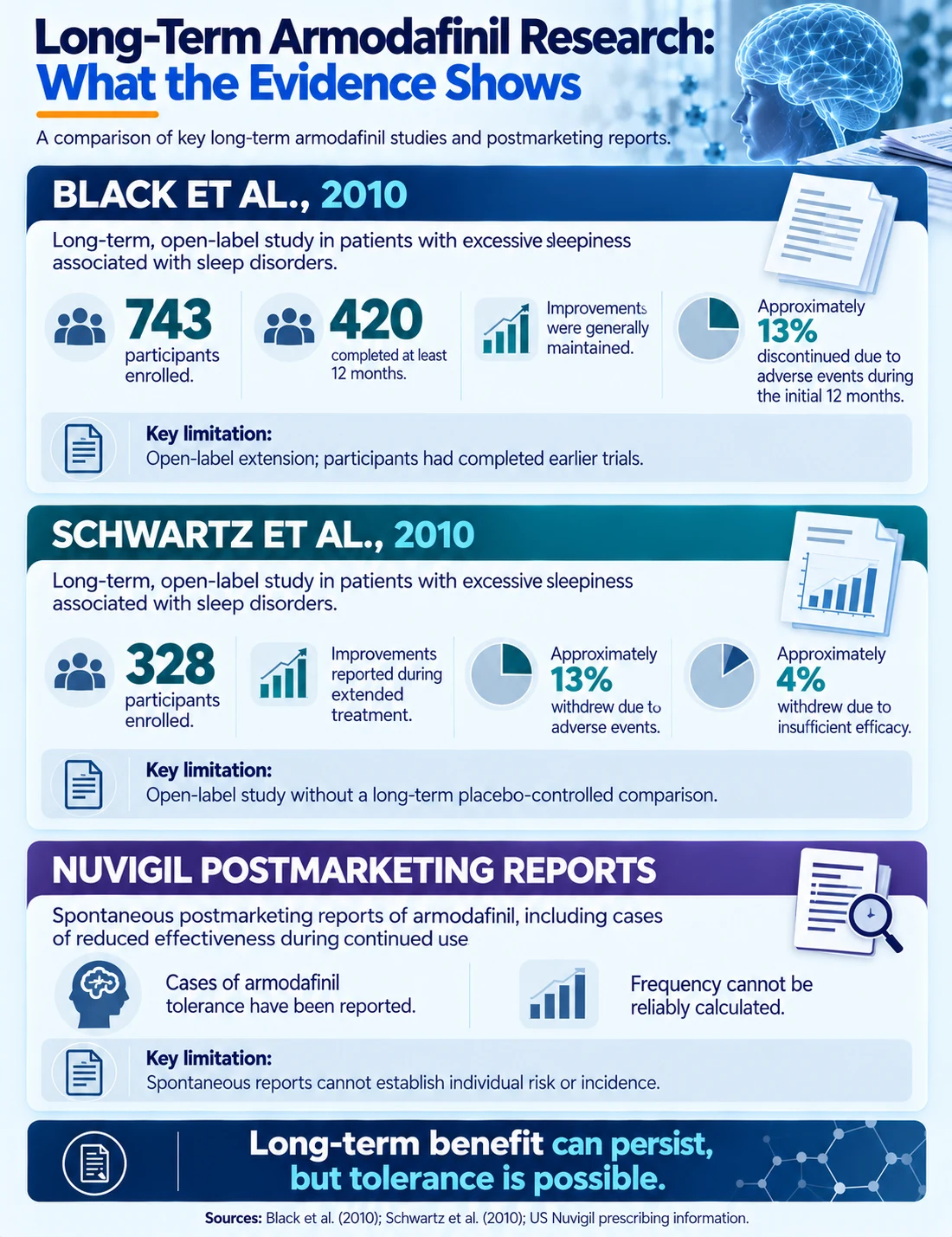
The open-label extension enrolled 743 patients with excessive sleepiness associated with treated obstructive sleep apnoea, shift work disorder or narcolepsy.
Of these participants, 420 (approximately 57%) completed at least 12 months of treatment.
Researchers assessed sleepiness, fatigue and overall clinical improvement using established measures, including the Epworth Sleepiness Scale.
Improvements were generally maintained during extended treatment.
However, 95 participants, approximately 13% of those enrolled, discontinued because of adverse events during the initial 12 months. These findings demonstrate sustained benefit among some patients while highlighting the importance of tolerability.
Schwartz et al., 2010
A separate study by Schwartz and colleagues enrolled 328 adults who had not previously received armodafinil.
Participants had excessive sleepiness associated with treated obstructive sleep apnoea, shift work disorder or narcolepsy.
The 12-month open-label study, with an extension period, reported improvements in wakefulness and overall clinical condition.
The study reported that approximately 13% of participants withdrew because of adverse events and 4% because of insufficient efficacy.
Together, the studies support the possibility of sustained benefit during extended armodafinil treatment in selected patients.
| Evidence | Main finding | Important limitation |
|---|---|---|
| Black et al., 2010 | Improvements were generally maintained during prolonged treatment | Open-label design and selection of earlier-trial completers |
| Schwartz et al., 2010 | Improvements were reported during extended treatment | No long-term placebo-controlled comparison |
| Nuvigil postmarketing reports | Cases of tolerance have been reported | Incidence and individual risk cannot be reliably determined |
What Researchers Still Do Not Know
Both long-term studies were open-label, meaning participants and investigators knew which treatment was administered.
Unlike blinded, placebo-controlled research, this design may introduce expectation and reporting bias.
Some outcomes relied on participants’ assessments of sleepiness or fatigue. Furthermore, patients who tolerate treatment and experience benefits may be more likely to continue in extended studies.
The Australian TGA armodafinil assessment, published in 2016, provides historical context for the original clinical evidence and its limitations.
Important uncertainties remain about the proportion of patients who develop tolerance, individual risk factors, differences between sleep disorders and changes in responsiveness over several years.
Dedicated Waklert-specific long-term clinical evidence is also limited.
Therefore, sustained effectiveness in research demonstrates continued benefit in the studied populations, not that tolerance is impossible.
These study limitations mean that the available evidence cannot predict Waklert tolerance for an individual patient.
Why Might Waklert Feel Less Effective Over Time?
A decline in perceived Waklert effectiveness may have several explanations. Genuine tolerance is one possibility, but it should not be assumed automatically.
Suspected Waklert tolerance should be evaluated alongside other reasons for persistent sleepiness.
Changes in Underlying Sleep Disorders
Excessive daytime sleepiness can fluctuate as an underlying medical condition changes.
For example, someone with obstructive sleep apnoea may experience continuing sleepiness if treatment of the airway obstruction becomes less effective.
Armodafinil promotes wakefulness but does not correct the underlying obstruction.
Likewise, changes in narcolepsy symptoms or other sleep-related conditions can affect overall treatment response.
Insufficient Sleep
Chronic sleep restriction can contribute to fatigue and excessive daytime sleepiness.
A wakefulness-promoting medicine does not replace adequate sleep.
Consequently, worsening sleep deprivation may make treatment seem less beneficial without demonstrating pharmacological tolerance.
Changes in Health or Other Medicines
New illnesses, psychiatric symptoms and changes in concurrent medications may influence daytime alertness.
Armodafinil also interacts with certain medicines through drug-metabolising pathways.
These factors may complicate the interpretation of reduced treatment effectiveness and warrant clinical assessment.
Individual Variation and Possible Tolerance
Responses to armodafinil differ between individuals and may fluctuate over time.
Pharmacological adaptation remains one possible explanation for a declining response, particularly given the postmarketing evidence.
However, perceived alertness alone cannot reliably distinguish tolerance from every other cause of persistent sleepiness.
Reduced effectiveness is therefore a clinical concern requiring assessment rather than automatic proof of tolerance.
As a result, possible Waklert tolerance needs clinical assessment rather than conclusions based on a single change in alertness.
Waklert Tolerance vs Dependence: What's the Difference?
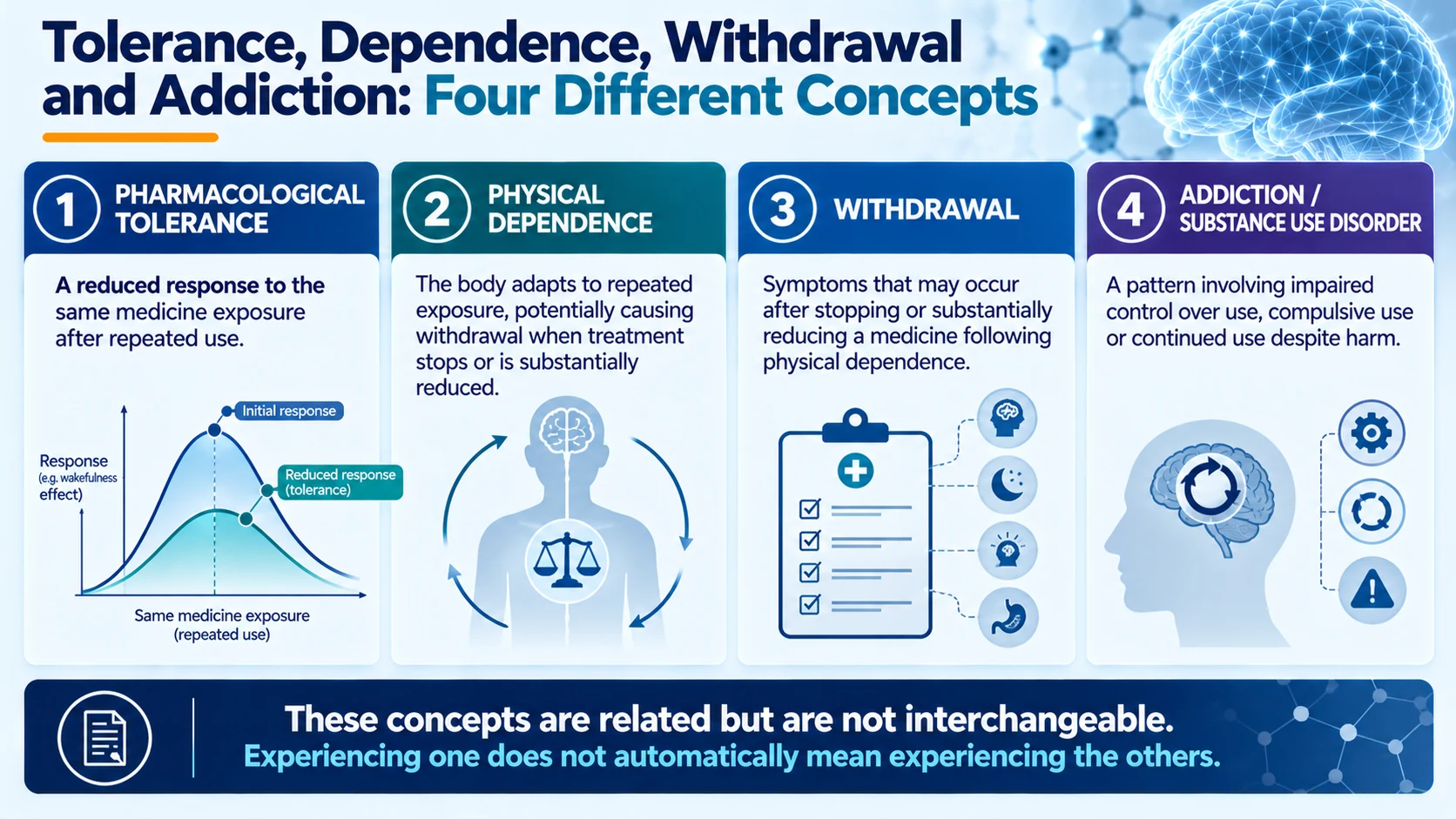
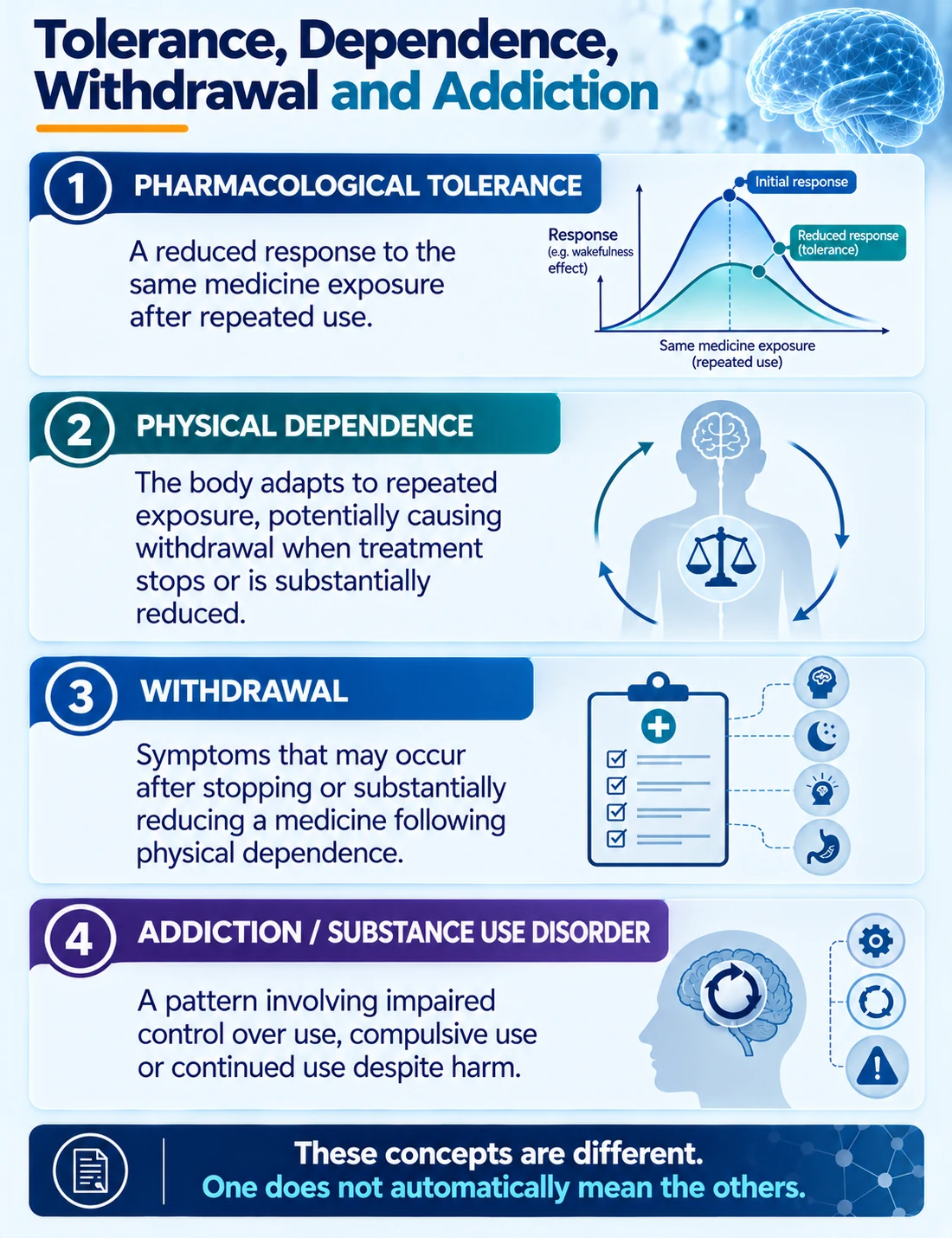
Tolerance, physical dependence, withdrawal and addiction describe distinct concepts.
Understanding Physical Dependence
Tolerance means the response to a medicine decreases following repeated exposure.
Physical dependence means the body has adapted to continued exposure. Stopping or substantially reducing the medicine may then produce withdrawal symptoms.
Withdrawal describes symptoms that can emerge after stopping or reducing a medicine following physiological adaptation.
Addiction, clinically associated with substance use disorder, involves features such as impaired control, compulsive use and continued use despite harm.
A person may develop tolerance without clinically significant withdrawal. Likewise, physical dependence does not automatically indicate addiction.
The US Nuvigil prescribing information recognises that physical dependence can occur during chronic armodafinil treatment. However, it does not establish that everyone receiving treatment will become dependent.
Misuse and Withdrawal Considerations
Australian Nuvigil information discusses abuse and dependence potential, drawing partly on evidence involving the related medicine modafinil.
More recent US Nuvigil prescribing information reports withdrawal symptoms following abrupt cessation or substantial reduction after chronic use.
Reported symptoms include sweating, shaking, nausea, fatigue, insomnia and psychiatric changes. More serious events have also appeared in postmarketing reports.
Such reports do not establish a dependable withdrawal rate for Waklert or prove that every reported event resulted solely from armodafinil.
Withdrawal must also be distinguished from a return of the excessive sleepiness for which the medicine was prescribed.
Concerns about dependence, misuse or stopping treatment should be discussed with the prescribing clinician.
Does Long-Term Waklert Use Affect Safety?
Long-term armodafinil treatment requires clinical monitoring because continued effectiveness does not necessarily mean treatment remains suitable or free from adverse effects.
The Black et al. extension study reported modest average increases in blood pressure and heart rate, supporting attention to cardiovascular monitoring during treatment.
Other considerations include sleep disturbance, psychiatric symptoms, medication interactions and new adverse reactions.
Australian Nuvigil information identifies precautions involving cardiovascular conditions, psychiatric reactions and serious skin or hypersensitivity reactions.
Although these reactions are not necessarily specific to prolonged exposure, they remain important throughout treatment.
Clinical monitoring may include the ongoing control of daytime sleepiness, blood pressure, cardiovascular symptoms, sleep quality, mood and changes in other medicines.
The appropriate monitoring approach depends on each patient’s diagnosis, medical history and clinical circumstances.
Long-term studies support continued benefit in some populations, but they cannot establish universal safety or suitability for every patient.
Monitoring for Waklert tolerance is only one aspect of reviewing long-term treatment safety and effectiveness.
What Should Patients Do if Waklert Seems Less Effective?
A noticeable decline in wakefulness-related benefit warrants medical review, particularly when armodafinil was prescribed for an established sleep disorder.
The main question is not simply whether tolerance has developed, but why treatment is no longer producing the expected result.
A clinician may reassess the diagnosis, symptoms, sleep patterns, concurrent medicines and treatment goals.
For someone with obstructive sleep apnoea, reviewing the effectiveness of treatment for the underlying airway obstruction may also be important.
Comparing current symptoms with the original response can help establish whether the change is persistent, intermittent or associated with another event.
Patients should not independently increase their dose, combine tablets, introduce medication breaks or change treatment schedules to overcome suspected tolerance.
There is insufficient evidence to recommend self-directed tolerance-reversal strategies, and unsupervised changes may introduce avoidable risks.
Appropriate treatment decisions depend on the underlying reason for reduced effectiveness.
If Waklert tolerance is suspected, patients should discuss the change with their prescriber rather than adjusting treatment independently.
Australian Prescription and Regulatory Considerations
In Australia, armodafinil is classified as a Schedule 4 (S4) prescription-only medicine.
This scheduling classification must be distinguished from the Australian registration status of individual products.
Armodafinil is the active pharmaceutical ingredient.
Nuvigil is a separately branded armodafinil medicine registered in the Australian Register of Therapeutic Goods (ARTG).
Waklert is an overseas-branded armodafinil medicine whose regulatory status must be assessed independently.
The TGA lists Nuvigil 150mg under ARTG 226559.
In a 3 June 2021 enforcement announcement, the TGA stated that Waklert-branded tablets involved in an alleged unlawful importation were not included in the ARTG.
That historical finding alone does not establish the current registration status of every Waklert product.
Nuvigil’s Australian registration does not automatically confer approval or demonstrated bioequivalence on Waklert.
Likewise, long-term armodafinil research cannot independently verify the manufacturing quality or long-term outcomes of every overseas formulation.
Australian patients should follow applicable prescription requirements and obtain appropriate medical guidance.
Frequently Asked Questions
Waklert tolerance is possible because cases have been reported with armodafinil-containing Nuvigil. However, long-term studies have also demonstrated sustained wakefulness benefits in some patients. Tolerance is not inevitable.
Yes. Reduced effectiveness can occur, but it does not always indicate tolerance. Insufficient sleep, changes in medical conditions and concurrent medicines may also contribute.
No. Tolerance means a reduced response after repeated exposure. Physical dependence involves physiological adaptation that may produce withdrawal symptoms when treatment stops or is substantially reduced. Neither automatically means addiction.
Yes. Open-label studies published in 2010 reported sustained improvements during extended treatment, including periods of 12 months or longer. However, these studies have limitations and do not guarantee indefinite effectiveness or safety.
Yes. Insufficient or disrupted sleep may increase daytime sleepiness and reduce perceived wakefulness benefits without necessarily indicating pharmacological tolerance.
Relevant topics include changes in sleepiness, sleep duration, underlying disorders, concurrent medicines, adverse effects and treatment goals. Clinical assessment can identify possible explanations before treatment decisions are made.
Conclusion
Research indicates that armodafinil can remain effective during prolonged treatment for excessive daytime sleepiness associated with certain diagnosed sleep disorders.
Clinical studies lasting 12 months or longer have documented sustained benefits in many participants. However, these findings do not establish that tolerance never develops.
Postmarketing reports confirm that armodafinil tolerance has been observed, although its frequency, individual risk factors and long-term course remain uncertain.
Reduced perceived effectiveness may also result from insufficient sleep, underlying medical conditions or other factors unrelated to pharmacological tolerance.
Tolerance should be distinguished from physical dependence, withdrawal and addiction.
For Australian readers, armodafinil research and Nuvigil’s registration do not independently establish Waklert-specific long-term outcomes or regulatory approval.
The evidence supports ongoing benefit in some patients while recognising that treatment response can change. Long-term management therefore requires appropriate clinical assessment and monitoring rather than assumptions about guaranteed effectiveness.

ModvigilAUS Medical Editorial Team
ModvigilAUS Health Research Desk is the internal editorial team behind ModvigilAUS.com's educational content on Modafinil and Armodafinil. All articles are prepared using publicly available medical and scientific references, Australian regulatory guidance, and internal editorial review standards.
See all author post
1 Comment