- Your cart is empty
- Continue Shopping

Waklert 150mg vs Armodafinil: Critical Differences You Must Know
- Armodafinil
- Posted on
-
by ModvigilAUS Medical Editorial Team
- 0 comments
Medical Disclaimer
Medical disclaimer: This article provides general educational information and does not replace advice from a qualified healthcare professional. It should not be used to self-prescribe armodafinil or independently change prescribed treatment.
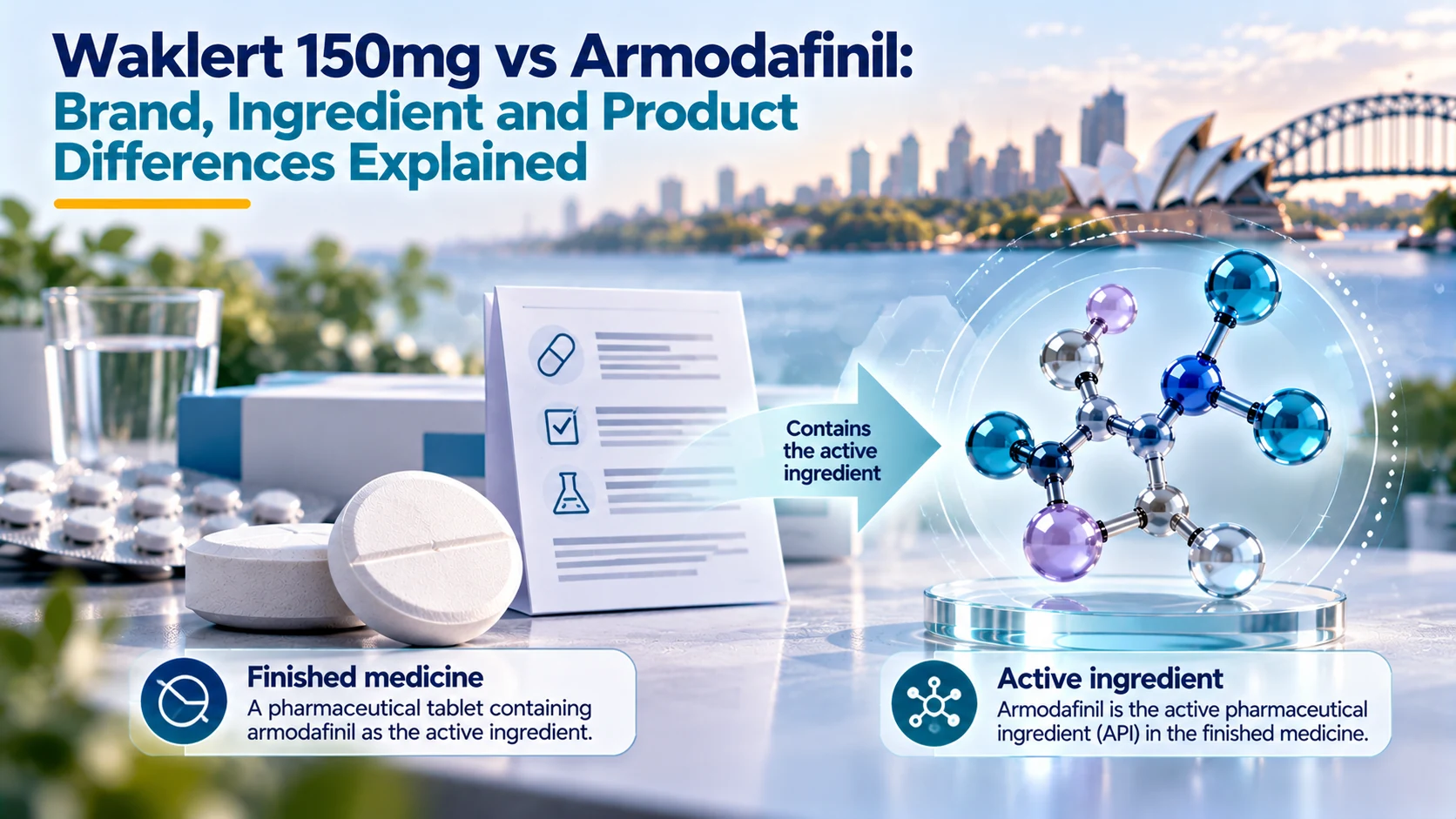
What is the difference between Waklert 150mg and armodafinil? Waklert 150mg is a branded tablet identified as containing armodafinil, while armodafinil is the active pharmaceutical ingredient.
People searching for waklert 150mg vs armodafinil may assume they are comparing two different medicines. However, the comparison concerns a finished pharmaceutical product and the substance responsible for its intended therapeutic activity.
Sharing an active ingredient does not automatically make different pharmaceutical products identical. Excipients, manufacturing processes, absorption characteristics and regulatory assessments can vary.
This distinction matters in Australia because prescription medicine registration applies to specific finished products, not automatically to every overseas brand containing the same ingredient.
Understanding these differences helps readers interpret medicine names, product formulations and claims of equivalence more accurately.
Waklert 150mg vs Armodafinil: What Is the Main Difference?
The main difference is pharmaceutical identity.
Waklert 150mg is a branded finished medicine. Armodafinil is its stated active ingredient.
An active pharmaceutical ingredient (API) is the substance responsible for a medicine’s intended pharmacological activity.
A finished medicine contains the API in a particular formulation, such as a tablet, alongside other ingredients needed for manufacturing, stability or administration.
These additional ingredients can help maintain tablet structure, influence disintegration or support production.
Therefore, asking whether Waklert is stronger or more effective than armodafinil is not a technically complete comparison.
Armodafinil alone does not identify a particular finished medicine, manufacturer or formulation.
A meaningful comparison would instead identify two specific armodafinil-containing products, including their strengths, dosage forms and supporting evidence.
This distinction explains why medicines containing the same ingredient can have different brand names, manufacturers and regulatory statuses.
The phrase “waklert 150mg vs armodafinil” therefore refers to a brand-versus-ingredient distinction, not a head-to-head clinical trial.
What Is Waklert 150mg?
Waklert 150mg is an overseas-branded tablet labelled as containing 150 milligrams of armodafinil.
The brand identifies a finished pharmaceutical product. The 150mg designation describes its stated active-ingredient content per tablet, not an individual’s appropriate prescribed regimen.
A tablet contains more than its active ingredient. Other components, called excipients, may support manufacturing, stability, appearance and disintegration.
Together, the formulation and manufacturing controls contribute to the finished medicine’s pharmaceutical identity.
Information about the manufacturer, ingredients, batch and applicable quality standards can help establish product characteristics.
However, a brand name or ingredient declaration does not independently authenticate an individual packet or establish compliance with Australian pharmaceutical standards.
Nor does it demonstrate that Waklert is bioequivalent to Nuvigil or another armodafinil formulation.
Identifying what a medicine claims to contain is different from independently verifying the quality or clinical equivalence of the finished product.
For a related brand comparison, see our Waklert vs Artvigil guide.
What Is Armodafinil?
Armodafinil is a prescription wakefulness-promoting pharmaceutical ingredient used in certain medical treatments involving excessive sleepiness.
It is closely related to modafinil, but their molecular compositions differ.
Modafinil contains two mirror-image molecular forms called the R- and S-enantiomers. Armodafinil consists of the R-enantiomer.
An enantiomer is one of two mirror-image forms of a molecule. These forms can differ in how the body processes and eliminates them.
The Australian TGA assessment of armodafinil describes these pharmacological distinctions.
Clinical research has examined armodafinil in patients with diagnosed sleep disorders.
In Australia, registered Nuvigil has indications involving excessive sleepiness associated with narcolepsy, shift work sleep disorder and obstructive sleep apnoea under specified circumstances.
These indications relate to the assessed Nuvigil medicine and must not automatically be treated as Waklert-specific Australian approvals.
Waklert vs Armodafinil: Product Comparison
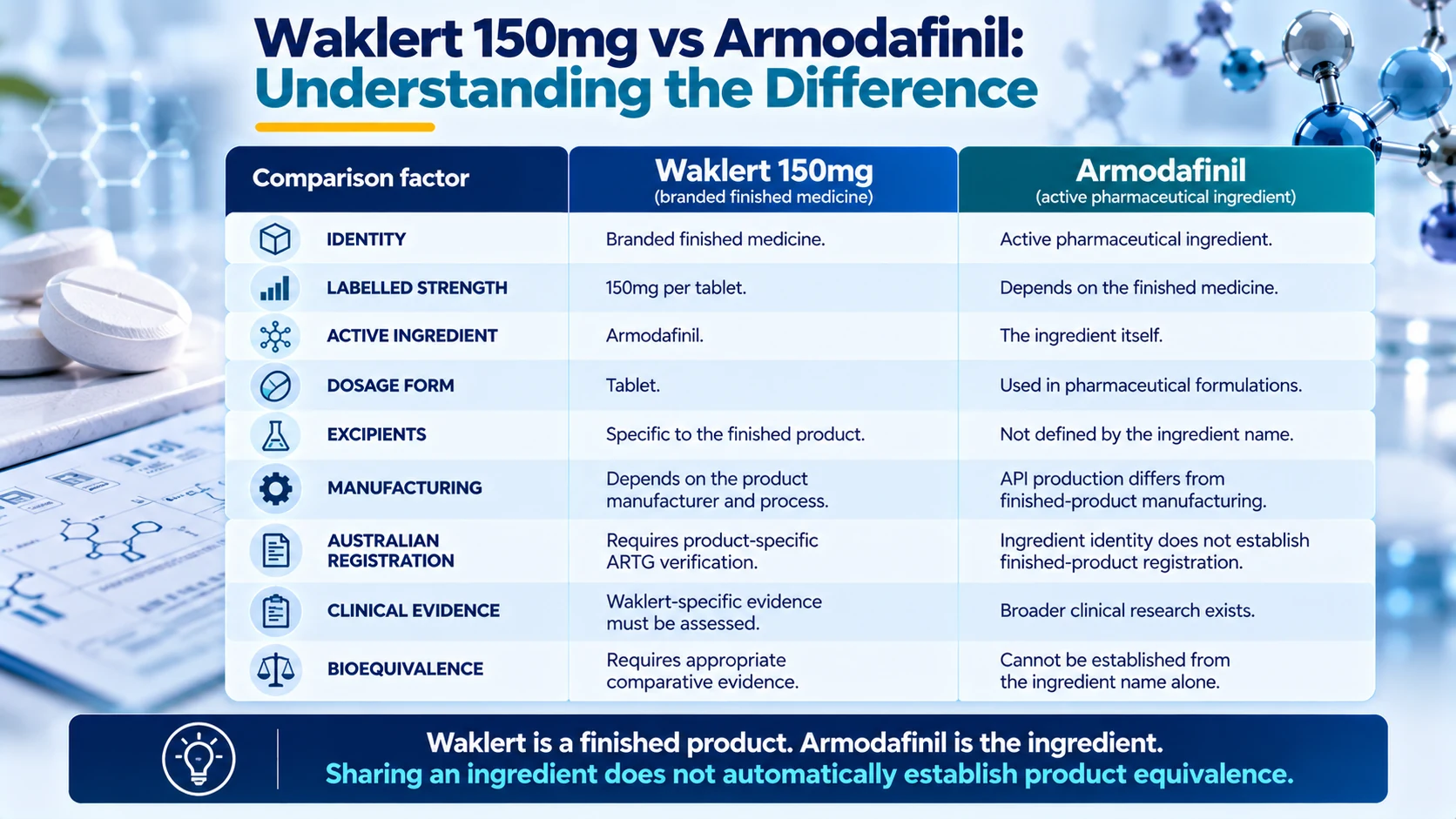
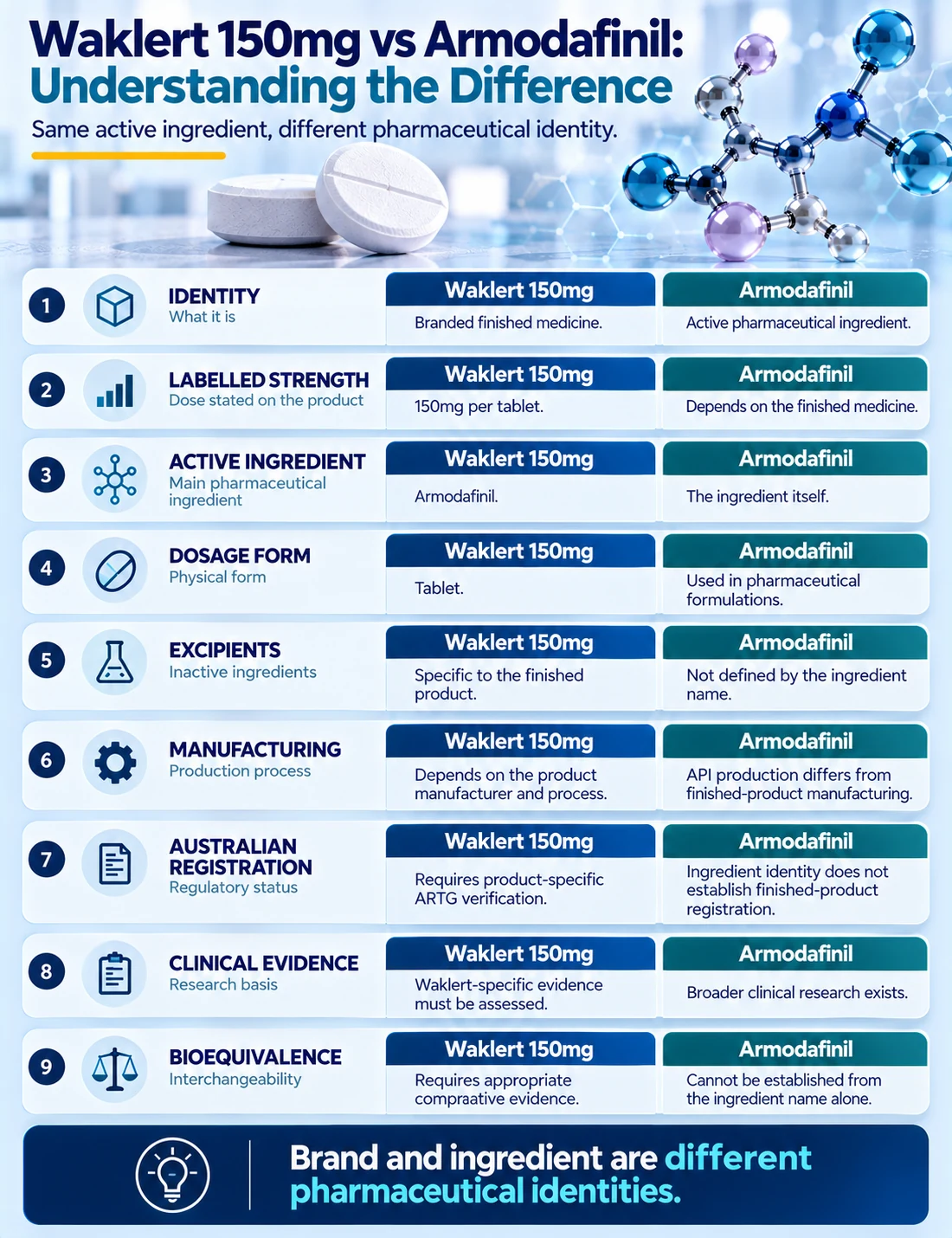
The following comparison explains why Waklert and armodafinil represent different levels of pharmaceutical identity.
Armodafinil identifies the substance producing the intended pharmacological activity. Waklert identifies a finished tablet intended to deliver that ingredient.
Consequently, comparing Waklert with another armodafinil medicine requires information beyond the ingredient name.
A waklert 150mg vs armodafinil comparison should begin with the product’s identity and the evidence available for that finished formulation.
Does Waklert Work Differently From Other Armodafinil Medicines?
Armodafinil’s intended pharmacological activity comes from its active ingredient. However, a finished medicine’s formulation and pharmaceutical quality can also influence drug availability.
Two products with the same labelled amount of armodafinil may have different excipients, manufacturing methods and tablet characteristics.
Such differences do not necessarily produce meaningful clinical differences.
Properly evaluated generic medicines can demonstrate comparable pharmaceutical performance.
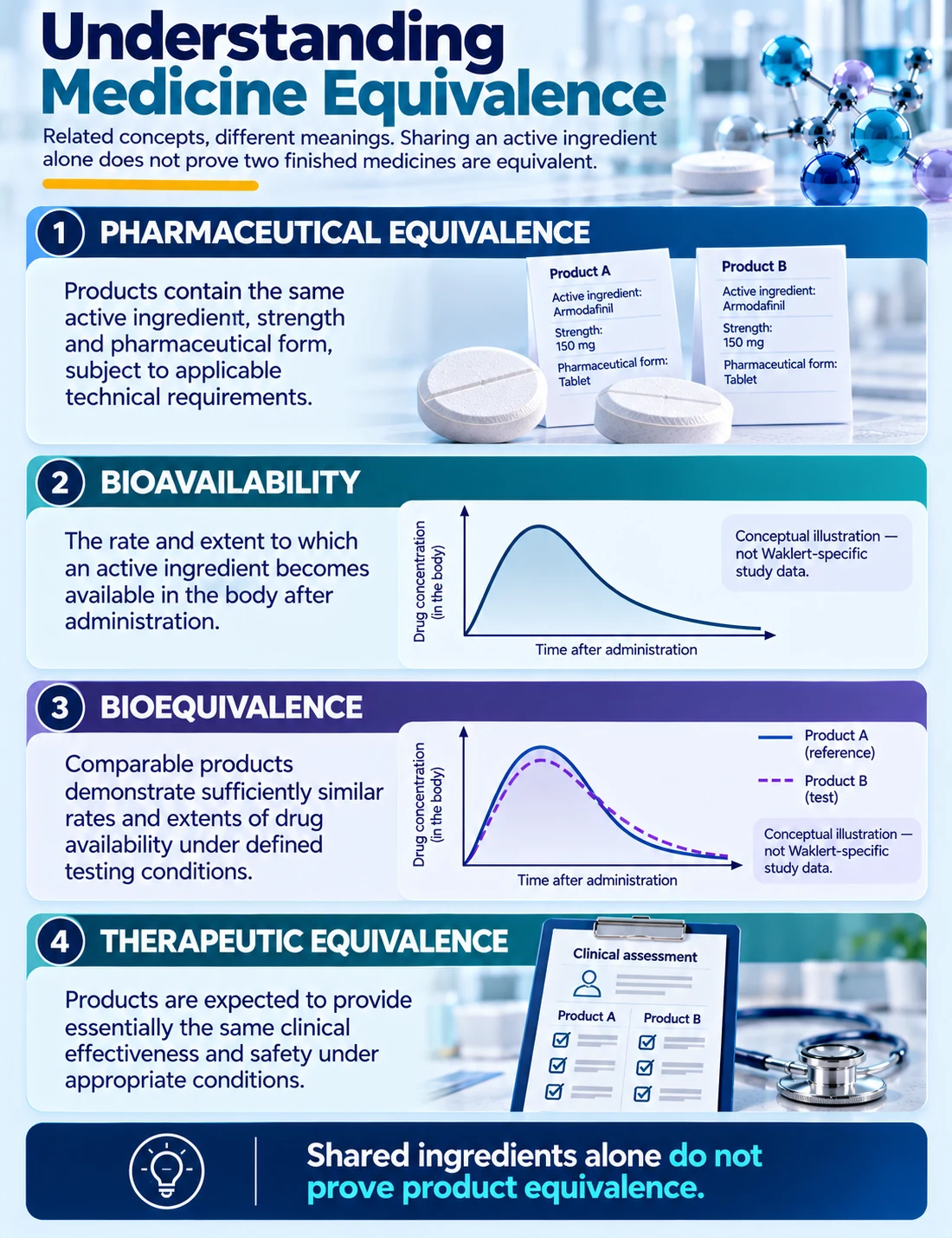
Two concepts help explain this:
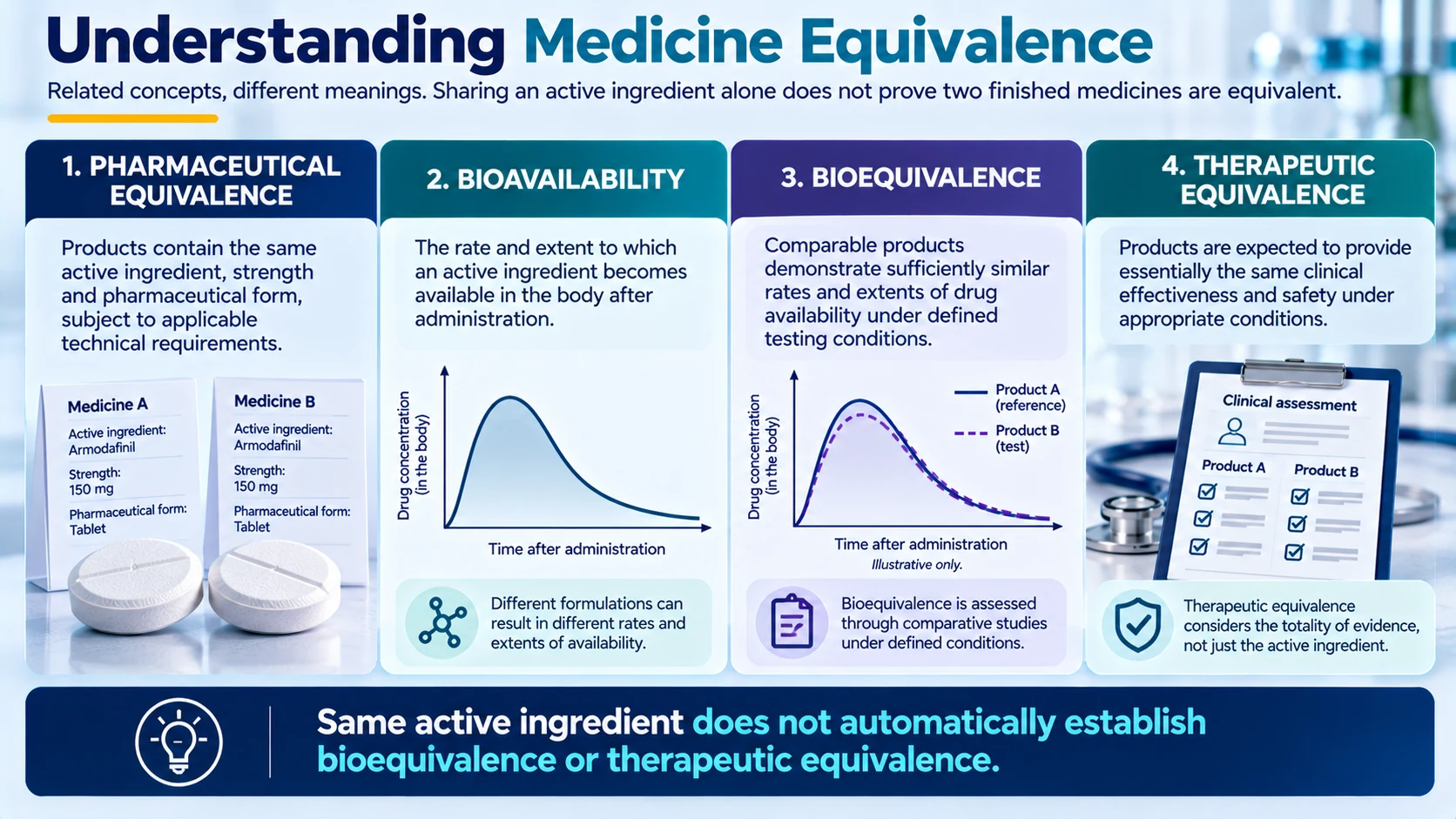
Bioavailability describes the rate and extent to which an active ingredient becomes available in the body after administration.
Bioequivalence describes whether comparable products deliver the ingredient at sufficiently similar rates and extents under recognised testing conditions.
The TGA’s generic prescription medicines fact sheet explains that Australian generic medicines must demonstrate bioequivalence with an appropriate reference medicine.
This assessment helps establish that formulation differences do not cause clinically significant differences in systemic exposure.
However, without appropriate Waklert-specific comparative evidence, identical absorption, onset, duration or effectiveness cannot be assumed.
Likewise, a different brand name does not establish that Waklert is stronger, weaker or clinically superior.
What Is the Difference Between Waklert and Nuvigil?
Active Ingredient and Formulation
Waklert and Nuvigil are separately branded medicines identified as containing armodafinil.
Both names refer to finished products rather than different active ingredients.
However, they do not necessarily contain identical excipients or undergo identical manufacturing and regulatory assessments.
Australian Nuvigil documentation provides information about its formulations, strengths and product-specific regulatory assessment.
Equivalent conclusions about Waklert require appropriate Waklert-specific evidence.
A comparison based only on the ingredient and labelled strength remains incomplete.
Clinical Evidence and Regulatory Assessment
Nuvigil has undergone Australian regulatory evaluation and is included in the Australian Register of Therapeutic Goods (ARTG).
Its clinical evidence supports the evaluation of that particular medicine.
Waklert is a separately branded overseas product. Nuvigil’s registration does not establish Waklert’s Australian approval or bioequivalence.
Clinical research involving Nuvigil may explain armodafinil pharmacology without proving that every overseas formulation provides identical drug exposure.
A reliable product comparison must consider the individual formulations and any suitable comparative studies.
Are All Armodafinil Brands Equivalent?
Not every medicine containing the same active ingredient is automatically interchangeable.
Three related concepts are important.
Pharmaceutical equivalence generally concerns products with the same active ingredient, strength and pharmaceutical form, subject to applicable technical requirements.
Bioequivalence concerns sufficiently comparable rates and extents of ingredient availability under defined testing conditions.
Therapeutic equivalence concerns expected clinical effectiveness and safety under appropriate conditions.
These concepts are related but not interchangeable.
The TGA evaluates Australian generic prescription medicines using evidence about manufacturing quality, ingredients, formulations and bioequivalence.
Such assessments commonly compare drug concentration profiles under controlled conditions.
Importantly, different excipients do not automatically make two products therapeutically different.
A properly evaluated generic medicine may contain different inactive ingredients while satisfying relevant Australian standards.
Conversely, similar-looking tablets or identical ingredient declarations do not establish bioequivalence without appropriate evidence.
Therefore, pharmaceutical interchangeability should be assessed using relevant regulatory and clinical information rather than assumptions based on branding.
People prescribed armodafinil should seek professional advice before changing between formulations.
In any waklert 150mg vs armodafinil discussion, evidence of equivalence must be distinguished from merely sharing an ingredient.
Australian Regulatory Status of Waklert and Armodafinil
Australian medicine regulation distinguishes between an ingredient’s legal scheduling and the registration of a finished therapeutic product.
Schedule 4 Prescription Classification
Armodafinil is classified as a Schedule 4 (S4) prescription-only medicine under Australia’s October 2026 Poisons Standard.
Schedule 4 medicines require appropriate prescribing and are subject to professional supply controls.
However, this classification does not establish that every branded armodafinil medicine is registered in Australia.
An ingredient’s scheduling and a product’s registration must be assessed separately.
Product-Specific ARTG Registration
The ARTG records therapeutic goods registered or otherwise included under Australian regulatory requirements.
The TGA lists Nuvigil 150mg under ARTG number 226559, with an active licence status.
Waklert is a different branded medicine.
In June 2021, the TGA published an enforcement announcement involving Waklert-branded tablets that were not included in the ARTG at that time.
That historical announcement does not independently establish Waklert’s present regulatory status.
A current Waklert-specific registration has not been conclusively established through this review.
Accordingly, Waklert should not be described as TGA-approved or ARTG-registered without current product-specific evidence.
Registration of Nuvigil does not automatically establish Australian approval for Waklert.
For further regulatory context, see our Australian armodafinil guide.
For Australian readers, waklert 150mg vs armodafinil also raises the separate question of whether a particular finished medicine has ARTG registration.
Safety Considerations When Comparing Armodafinil Products
Product authenticity and pharmaceutical quality are important when comparing armodafinil-containing medicines.
A product’s declared composition must correspond to what is actually supplied.
Excipients also matter. Although they do not provide the intended wakefulness-promoting activity, some individuals may have allergies or sensitivities relevant to particular formulations.
Armodafinil has recognised safety considerations, including serious skin and hypersensitivity reactions, psychiatric and cardiovascular precautions, and medicine interactions.
The Nuvigil ARTG record provides access to Australian Product Information.
Armodafinil can reduce the effectiveness of certain hormonal contraceptives. Pregnancy-related precautions also require particular attention.
The TGA recorded Nuvigil pregnancy-related safety changes approved in June 2025 and a warning involving ioflupane interactions approved in April 2026.
These findings provide relevant ingredient-level medical context. They do not independently establish Waklert’s pharmaceutical quality or equivalence.
Changes between prescribed medicines should involve appropriate professional guidance.
Our Waklert tolerance and long-term use article discusses related clinical evidence.
Frequently Asked Questions
Waklert 150mg is a branded finished medicine identified as containing armodafinil. Armodafinil is the active ingredient, not a competing brand. The terms describe different aspects of pharmaceutical identity.
Waklert 150mg is labelled as containing 150 milligrams of armodafinil per tablet. This describes the declared strength, not independent confirmation of an individual product’s authenticity.
Waklert is a branded armodafinil product. A generic armodafinil medicine is another finished product assessed under applicable generic-medicine requirements. Its formulation, approval and bioequivalence must be evaluated specifically.
No. Waklert and Nuvigil are separate brands identified as containing armodafinil. Nuvigil has Australian ARTG registration, which does not automatically establish Waklert’s registration or bioequivalence.
No. Sharing an active ingredient or labelled strength does not establish bioequivalence. Appropriate comparative evidence is needed to demonstrate sufficiently similar drug exposure.
Yes. Armodafinil is classified as a Schedule 4 prescription-only medicine under Australia’s October 2026 Poisons Standard.
Conclusion
The difference between Waklert 150mg and armodafinil is fundamentally a distinction between a finished branded medicine and its active pharmaceutical ingredient.
Waklert is identified as containing 150 milligrams of armodafinil per tablet. Armodafinil is the substance responsible for the intended pharmacological activity.
However, the same active ingredient does not automatically establish identical manufacturing quality, absorption characteristics or clinical equivalence.
Finished products may differ in excipients, manufacturing processes and regulatory assessment. Evidence of bioequivalence helps determine whether comparable medicines provide similar systemic drug exposure.
In Australia, Nuvigil is an ARTG-registered armodafinil medicine, while Waklert’s regulatory status must be evaluated independently.
Ultimately, understanding brand names, active ingredients and product-specific evidence helps readers interpret pharmaceutical claims accurately.
Understanding waklert 150mg vs armodafinil helps readers avoid mistaking ingredient identity for verified product equivalence.

ModvigilAUS Medical Editorial Team
ModvigilAUS Health Research Desk is the internal editorial team behind ModvigilAUS.com's educational content on Modafinil and Armodafinil. All articles are prepared using publicly available medical and scientific references, Australian regulatory guidance, and internal editorial review standards.
See all author post