- Your cart is empty
- Continue Shopping

Does Waklert Improve Focus or Mainly Promote Wakefulness?
- Armodafinil
- Posted on
-
by ModvigilAUS Medical Editorial Team
- 0 comments

Medical Disclaimer
This article provides general educational information only and does not replace advice from a qualified healthcare professional. It should not be used to self-prescribe armodafinil or independently change prescribed treatment.
Does Waklert improve focus, or does it primarily help people stay awake? Waklert’s stated active ingredient, armodafinil, primarily promotes wakefulness. Some clinical studies also report improvements in specific attention and memory tests, particularly among people experiencing excessive sleepiness.
However, improved alertness does not necessarily mean better concentration, reasoning or overall cognitive ability.
Waklert is an overseas-branded armodafinil medicine. Most available clinical evidence involves other armodafinil formulations, including Nuvigil, rather than Waklert specifically.
Understanding Waklert focus claims therefore requires distinguishing wakefulness, attention and broader cognitive performance, while recognising the limitations of clinical research.
Does Waklert Improve Focus?
Armodafinil primarily promotes wakefulness. Improvements in attention may occur when excessive sleepiness interferes with someone’s ability to remain engaged in a task.
For example, a person experiencing excessive daytime sleepiness may struggle to concentrate because they repeatedly become drowsy.
When treatment improves wakefulness, certain attention-related tasks may become easier.
However, improved wakefulness is not the same as enhanced cognitive ability.
Someone may respond more consistently to information without demonstrating stronger memory, reasoning or executive function.
Clinical research involving armodafinil has reported improvements in selected attention measures among patients with diagnosed sleep disorders.
These findings cannot automatically be generalised to healthy, adequately rested people.
There is also a product-specific distinction. Research involving Nuvigil or investigational armodafinil formulations provides evidence about the ingredient, but does not independently establish Waklert’s bioequivalence or clinical performance.
Consequently, claims that Waklert consistently produces stronger focus require direct supporting evidence.
How Does Armodafinil Promote Wakefulness?
Armodafinil acts on the central nervous system and belongs to a class of wakefulness-promoting medicines.
It is closely related to modafinil. However, modafinil contains two molecular forms, called R- and S-enantiomers, while armodafinil consists of the R-enantiomer.
An enantiomer is one of two mirror-image forms of a molecule.
The precise mechanism by which armodafinil promotes wakefulness remains incompletely understood.
Australian Nuvigil pharmacological information describes interactions with dopamine transport processes.
Dopamine is a neurotransmitter involved in several neurological functions, including movement, motivation and aspects of alertness.
Armodafinil can inhibit dopamine reuptake through its interaction with dopamine transporters, influencing dopamine availability in the nervous system.
However, this interaction does not fully explain its wakefulness-promoting effects or establish broad cognitive enhancement.
Australian Prescriber’s review of armodafinil also recognises uncertainty about the precise mechanism.
Therefore, armodafinil should not be characterised as a medicine that increases every aspect of brain performance.
Its established therapeutic role concerns excessive sleepiness in specified medical conditions.
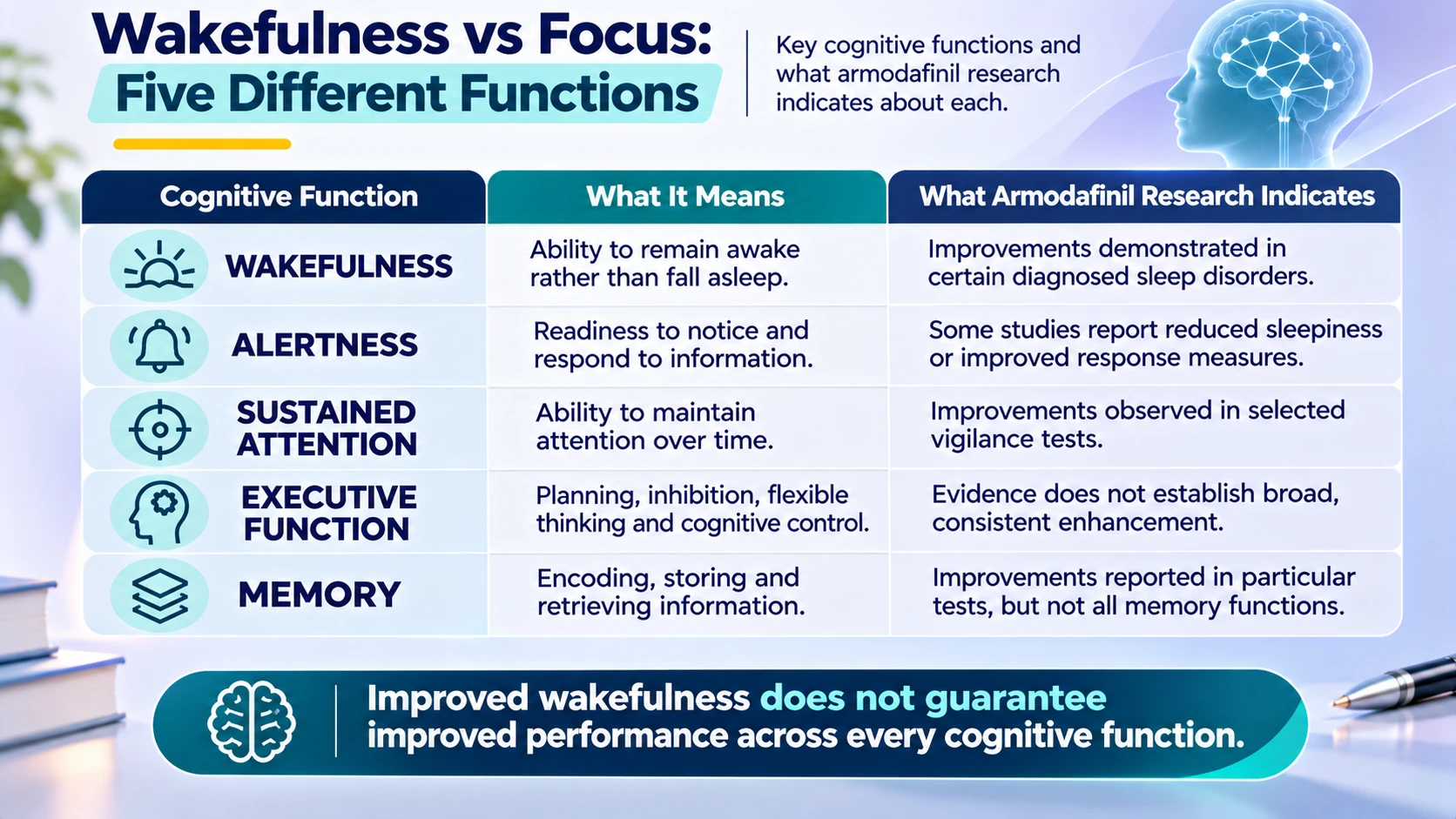
Wakefulness vs Focus: What Is the Difference?
These distinctions explain why someone may feel more mentally alert without improving across every cognitive domain.
| Function | What it means | What armodafinil evidence indicates |
|---|---|---|
| Wakefulness | Ability to remain awake rather than fall asleep | Improvements demonstrated in certain diagnosed sleep disorders |
| Alertness | Readiness to notice and respond to information | Some studies report reduced sleepiness or improved response measures |
| Sustained attention | Ability to maintain attention over time | Improvements observed in selected vigilance tests |
| Executive function | Planning, inhibition, flexible thinking and cognitive control | Evidence does not establish broad, consistent enhancement |
| Memory | Encoding, storing and retrieving information | Improvements reported in particular tests, but not all memory functions |
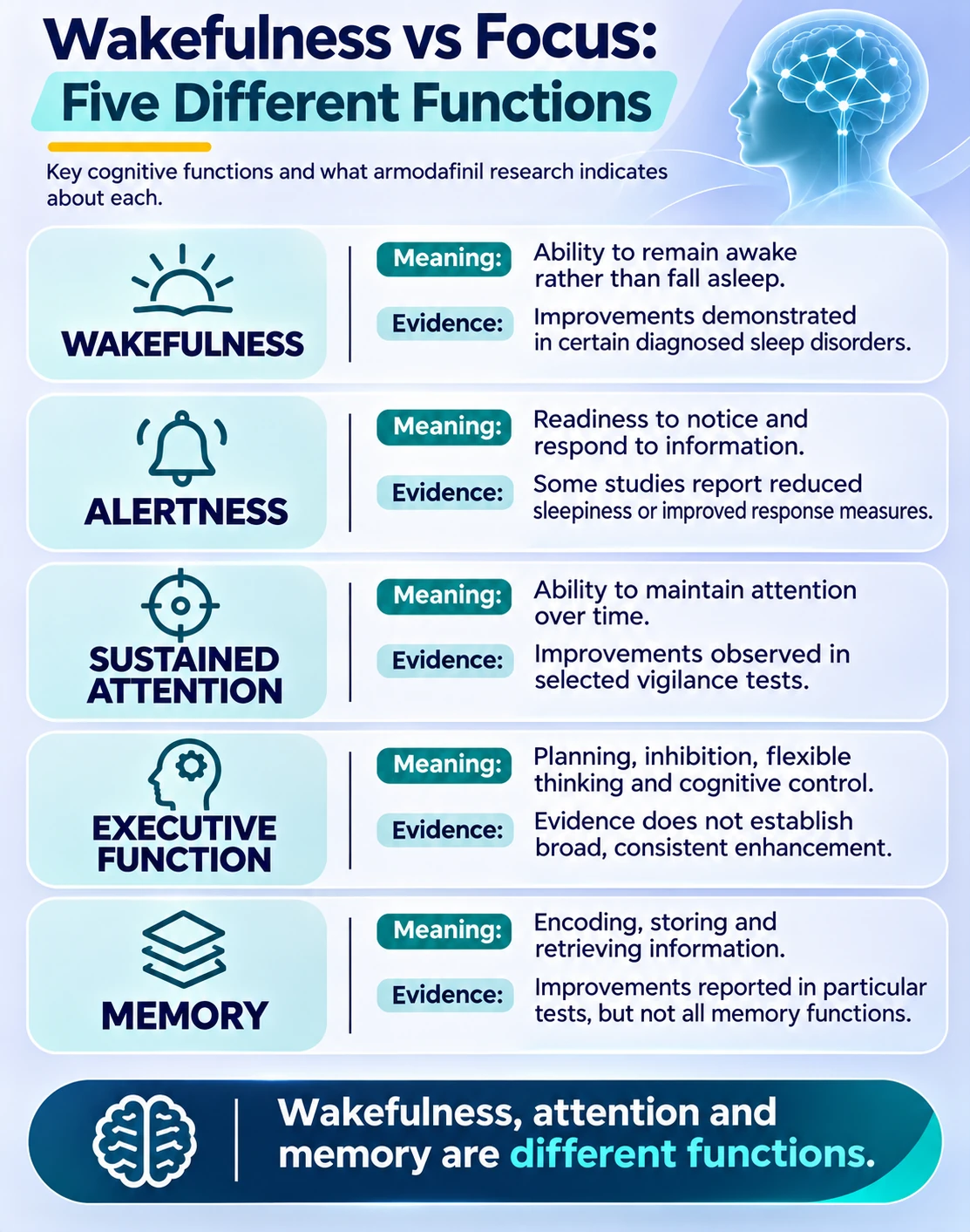
These distinctions explain why someone may feel more mentally alert without improving across every cognitive domain.
For example, faster responses to a visual signal do not necessarily mean stronger complex reasoning.
Similarly, better performance on one memory assessment cannot establish improved learning ability overall.
Wakefulness can support concentration, but it does not determine all aspects of cognitive performance.
Waklert focus claims should not confuse reduced drowsiness with proven improvements in memory, reasoning or executive function.
What Does Clinical Research Say About Armodafinil and Attention?
Evidence in Diagnosed Sleep Disorders
Armodafinil has been studied in people with narcolepsy, shift work sleep disorder and residual excessive sleepiness associated with treated obstructive sleep apnoea.
These conditions can impair attention because remaining awake is difficult.
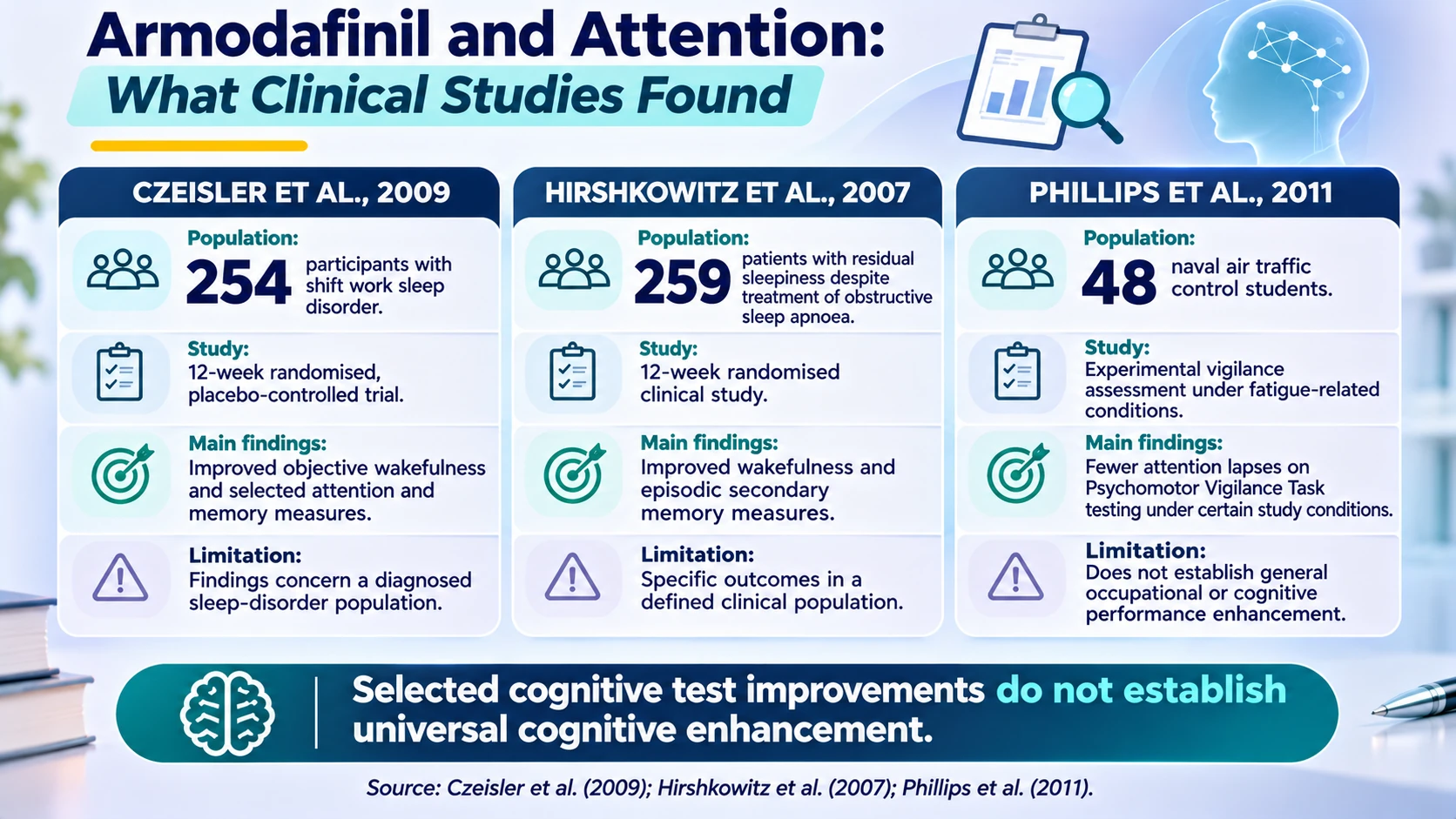
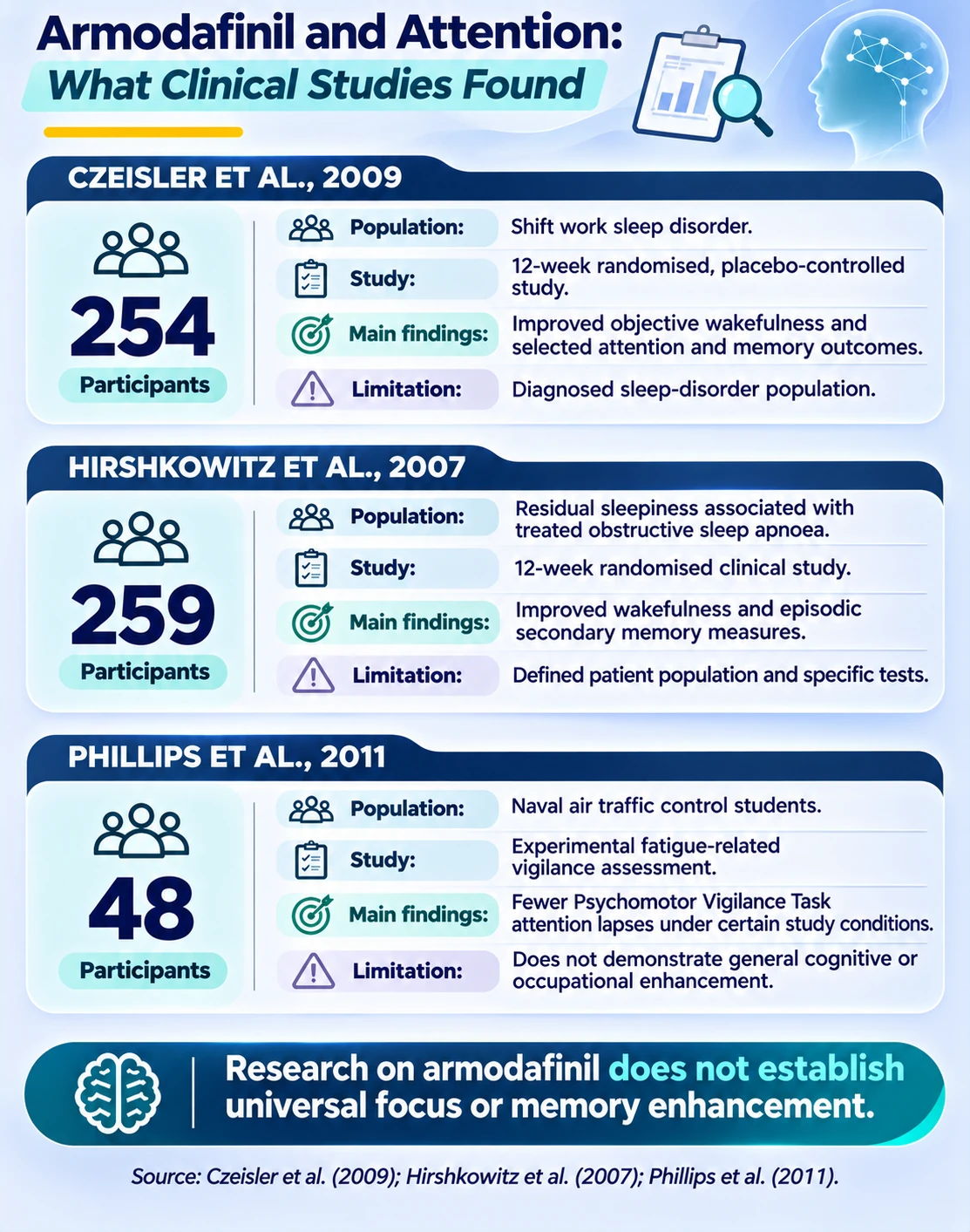
A 2009 randomised, placebo-controlled trial by Czeisler and colleagues examined 254 participants with shift work sleep disorder over 12 weeks.
Armodafinil improved objective wakefulness and reduced reported sleepiness compared with placebo.
Researchers also reported improvements in selected attention and memory assessments.
These results support benefits in a defined clinical population, not general cognitive enhancement.
Another randomised study by Hirshkowitz and colleagues involved 259 patients with residual sleepiness despite treatment of obstructive sleep apnoea using nasal continuous positive airway pressure.
The 12-week study reported improvements in wakefulness and episodic secondary memory.
Episodic secondary memory concerns the retention and recall of previously encountered information.
However, improvements on particular tests do not establish better performance across every memory function.
Neither study directly establishes Waklert-specific outcomes in healthy individuals. 
Attention and Cognitive Testing
Researchers use different tools to measure wakefulness and cognitive performance.
The Maintenance of Wakefulness Test measures a person’s ability to remain awake under controlled, sleep-promoting conditions.
The Psychomotor Vigilance Task (PVT) evaluates sustained attention using responses to repeated stimuli.
PVT researchers examine reaction times and attention lapses, which are unusually slow responses indicating reduced vigilance.
These measurements do not directly assess intelligence or general reasoning ability.
A 2011 armodafinil study involving 48 naval air traffic control students investigated vigilance under fatigue-related experimental conditions.
The researchers reported fewer PVT attention lapses under certain study conditions.
However, the findings do not establish improved academic achievement, occupational success or general cognitive performance.
It is also important to distinguish armodafinil studies from research involving modafinil.
Although the medicines are related, results from one cannot automatically establish identical outcomes for the other.
Evidence used to discuss Waklert focus comes primarily from armodafinil studies involving specific populations and measured outcomes.
Limitations of Available Evidence
The strongest clinical evidence concerns improving wakefulness in patients experiencing medically significant sleepiness.
Research into broader cognitive effects is less conclusive.
Some study participants begin with impaired alertness. Their improvement may therefore represent better management of sleepiness rather than enhancement beyond normal functioning.
Research also varies in study duration, participant selection and cognitive tests.
Additionally, subjective feelings of mental clarity do not always correspond with objective improvements in complex cognitive performance.
Most importantly, sufficient product-specific clinical evidence has not been established to conclude that Waklert reproduces every finding reported with other armodafinil formulations.
Does Armodafinil Improve Cognitive Performance in Healthy People?
Evidence supporting armodafinil treatment for excessive sleepiness does not establish reliable cognitive enhancement in healthy, adequately rested people.
Someone with a diagnosed sleep disorder may experience attention difficulties because of abnormal sleepiness.
Improving wakefulness can help address that impairment.
However, a healthy individual without excessive sleepiness does not necessarily have the same impairment.
Studies involving healthy participants have examined vigilance, reaction time and particular cognitive tests under controlled conditions.
These results cannot automatically predict academic outcomes, creativity, intelligence or real-world performance.
A 2019 systematic review and meta-analysis by Kredlow and colleagues, published in the Journal of Clinical Psychopharmacology, examined modafinil in non-sleep-deprived adults.
Across 19 placebo-controlled trials, the researchers identified a small overall positive cognitive effect, with a pooled effect size of approximately 0.10.
The review concerned modafinil, not armodafinil or Waklert.
Therefore, it cannot establish Waklert-specific cognitive enhancement. 
The available evidence does not support claims that Waklert reliably improves studying, productivity or general intellectual performance in healthy people.
Can Reduced Sleepiness Make Concentration Feel Better?
Yes. Reduced sleepiness can make concentration feel easier when drowsiness previously interfered with attention.
Excessive sleepiness may cause slower responses, difficulty maintaining mental effort and repeated interruptions in engagement.
Improving wakefulness may reduce these difficulties.
For someone receiving prescribed treatment for a diagnosed sleep disorder, better alertness can support normal waking activities.
However, this does not mean the medicine increases underlying intellectual ability.
Feeling mentally clearer may reflect reduced fatigue rather than improved memory formation or executive control.
Clinical research supports selected attention benefits in sleepy patient populations, but these findings cannot guarantee improvements across every cognitive task.
Armodafinil also does not replace adequate sleep or appropriate treatment of the underlying disorder.
Does Waklert Improve Memory or Executive Function?
Some armodafinil studies report improvements in particular memory assessments. However, the evidence does not establish broad enhancement of memory or executive function.
Working memory involves holding and manipulating information over short periods.
Long-term memory concerns storing and retrieving information over longer intervals.
Executive function includes planning, decision-making, inhibition and flexible thinking.
These functions are related but not interchangeable.
For example, better delayed word recall does not necessarily mean stronger working memory or improved decision-making.
The Czeisler shift work disorder study reported improvements in selected memory and attention outcomes.
Similarly, the Hirshkowitz study identified improvements in episodic secondary memory among patients with treated obstructive sleep apnoea.
These results apply to specific tests and patient populations.
They do not demonstrate that Waklert universally improves memory, learning or executive function.
What Factors Influence Perceived Focus?
Several factors can affect perceived concentration independently of armodafinil.
Sleep quality and baseline sleepiness: Insufficient or disrupted sleep can interfere with sustained attention and influence how noticeable a treatment response feels.
Underlying medical conditions: Sleep disorders, mental health conditions and other illnesses can affect concentration.
Individual response: Experiences of alertness vary. Subjective improvements do not necessarily establish measurable enhancement in cognitive ability.
Concurrent medicines: Other medicines can influence sleepiness, alertness or interactions requiring clinical assessment.
Psychological and environmental factors: Stress, anxiety, distractions, task complexity and motivation can affect concentration and performance.
These variables make perceived focus difficult to interpret as a direct measurement of a medicine’s cognitive effects.
Safety and Australian Prescription Considerations
Armodafinil is classified as a Schedule 4 prescription-only medicine under Australia’s October 2026 Poisons Standard.
The TGA lists Nuvigil 150mg under ARTG number 226559, with active registration status.
Waklert is a separately branded overseas medicine. Nuvigil’s registration does not establish Waklert’s Australian approval or bioequivalence.
Australian Nuvigil safety information identifies precautions concerning serious skin reactions, hypersensitivity, psychiatric symptoms, cardiovascular conditions and interactions.
Armodafinil can reduce the effectiveness of certain hormonal contraceptives.
The TGA also recorded Nuvigil pregnancy-related safety revisions approved on 9 June 2025 and an interaction warning involving ioflupane approved on 22 April 2026. 
These considerations reinforce why medical assessment is essential and why cognitive-enhancement claims should not encourage non-prescribed use.
Australian law also generally prohibits public advertising of prescription medicines, subject to limited exceptions.
Educational discussion on a commercial website does not automatically establish advertising compliance.
Frequently Asked Questions
Does Waklert help with focus?
Armodafinil may improve selected attention measures in people experiencing excessive sleepiness. However, evidence does not establish reliable Waklert-specific focus enhancement, particularly in healthy individuals.
Is Waklert mainly a wakefulness-promoting medicine?
Yes. Waklert is identified as containing armodafinil, a wakefulness-promoting medicine studied for excessive sleepiness associated with certain diagnosed disorders.
Does armodafinil improve concentration in people with sleep disorders?
Some controlled studies have reported improvements in selected attention and memory tests among patients with shift work sleep disorder or treated obstructive sleep apnoea. Results depend on the studied population and outcome measures.
Can Waklert improve memory?
Certain armodafinil studies report improvements in specific memory assessments. However, these findings do not establish that Waklert reliably improves all aspects of memory or learning.
Is increased alertness the same as improved cognitive performance?
No. Alertness concerns readiness to respond, while cognitive performance also includes memory, reasoning, executive function and sustained attention. Improvements in one domain do not guarantee improvements in others.
Is Waklert approved as a cognitive enhancer in Australia?
No Waklert-specific Australian approval for cognitive enhancement has been established. The Australian Nuvigil indications concern excessive sleepiness associated with specified medical conditions, not general cognitive enhancement.
Conclusion
Waklert is identified as containing armodafinil, whose primary established clinical role is promoting wakefulness.
Research shows that armodafinil can improve certain attention and memory measures in patients with excessive sleepiness associated with diagnosed sleep disorders.
However, improved wakefulness does not automatically establish better intelligence, executive function or overall cognitive performance.
Findings depend on the participants, study conditions and specific tests used.
Evidence involving modafinil should not be confused with armodafinil research. Likewise, clinical evidence concerning Nuvigil or other formulations does not automatically establish Waklert-specific effects.
For Australian readers, the distinction between treating excessive sleepiness and attempting to enhance normal cognitive function is especially important.
Ultimately, Waklert focus is a question about wakefulness and selected attention outcomes, not an established promise of broader cognitive improvement.

ModvigilAUS Medical Editorial Team
ModvigilAUS Health Research Desk is the internal editorial team behind ModvigilAUS.com's educational content on Modafinil and Armodafinil. All articles are prepared using publicly available medical and scientific references, Australian regulatory guidance, and internal editorial review standards.
See all author post