- Your cart is empty
- Continue Shopping

How Long Does Waklert Last? Onset, Duration and Timing
- Armodafinil
- Posted on
-
by ModvigilAUS Medical Editorial Team
- 0 comments

Medical Disclaimer
Educational information only, not medical advice. Armodafinil is prescription-only in Australia. Nuvigil registration does not establish Waklert registration or equivalence. Consult a qualified healthcare professional.
How long does Waklert last after taking a tablet? Waklert contains armodafinil, a long-acting wakefulness-promoting medicine with an approximately 15-hour elimination half-life. However, this does not mean its noticeable wakefulness effects last exactly 15 hours.
Waklert is an overseas-branded armodafinil product. Australian clinical information for Nuvigil, a separately branded medicine containing armodafinil, helps explain how the active ingredient behaves in the body.
The onset, intensity and duration of effects can differ between individuals. Food intake, metabolism, underlying medical conditions and other medicines may influence the response.
Understanding Waklert’s duration requires separating four concepts: when effects begin, when blood concentrations peak, how long wakefulness-related benefits persist and how long armodafinil remains in the body.
How Long Does Waklert Last?
To understand how long does Waklert last as a clinical question, it helps to start with its active ingredient, armodafinil, a relatively long-acting wakefulness-promoting medicine. Its effects may extend across a substantial portion of the waking period, but no clinically established number of hours guarantees how long Waklert will feel effective for every person.
Australian clinical information for Nuvigil provides evidence about armodafinil’s absorption and elimination. These findings help explain the active ingredient’s expected behaviour, although they do not establish Waklert-specific clinical effectiveness or product equivalence.
A common misunderstanding is that a medicine’s half-life represents its duration of action. In reality, the two measurements describe different processes.
Duration of action concerns the period during which a medicine produces a clinically meaningful effect. Elimination half-life describes the time required for its concentration to decrease by approximately half during the terminal elimination phase.
Armodafinil may continue circulating after its strongest perceived wakefulness effects have diminished. Conversely, measurable blood concentrations do not guarantee a particular level of alertness.
Clinical studies of armodafinil have demonstrated improvements in wakefulness in certain diagnosed sleep disorders. However, those outcomes cannot be converted into one universal duration for Waklert 150mg.
The key distinction is between how long armodafinil remains in the body and how long an individual experiences a meaningful reduction in sleepiness.
How Quickly Does Waklert Start Working?
Understanding Onset of Effects
When considering how long does Waklert last, onset is a separate measure: it refers to when a wakefulness-related response first begins after taking armodafinil.
Following oral administration, armodafinil passes through the gastrointestinal tract and enters the bloodstream. As circulating concentrations increase, the medicine can begin producing pharmacological effects.
However, absorption does not necessarily coincide with a noticeable improvement in alertness.
Some people may perceive a gradual reduction in sleepiness, while others may find the change less obvious. Existing fatigue, sleep quality and the underlying medical condition can influence the experience.
Importantly, there is no well-established Waklert-specific clinical onset time that reliably applies to every individual.
Claims that Waklert always starts working within a precise number of minutes should therefore be interpreted cautiously without appropriate product-specific evidence.
Time to Peak Concentration
The question how long does Waklert last cannot be answered from peak plasma concentration alone. This measurement is the highest concentration of a medicine in the bloodstream after administration. Researchers describe the time needed to reach this concentration as Tmax.
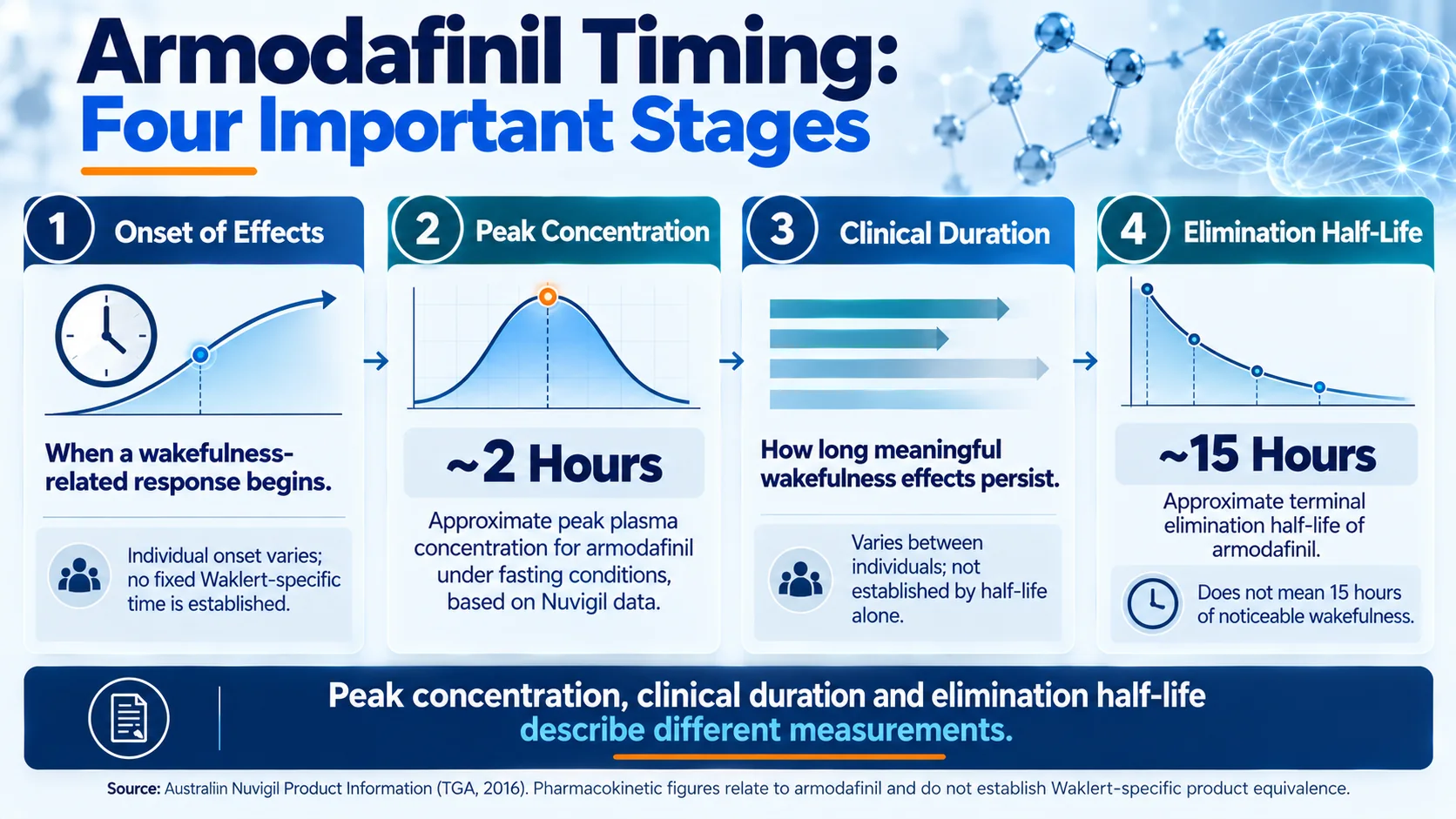
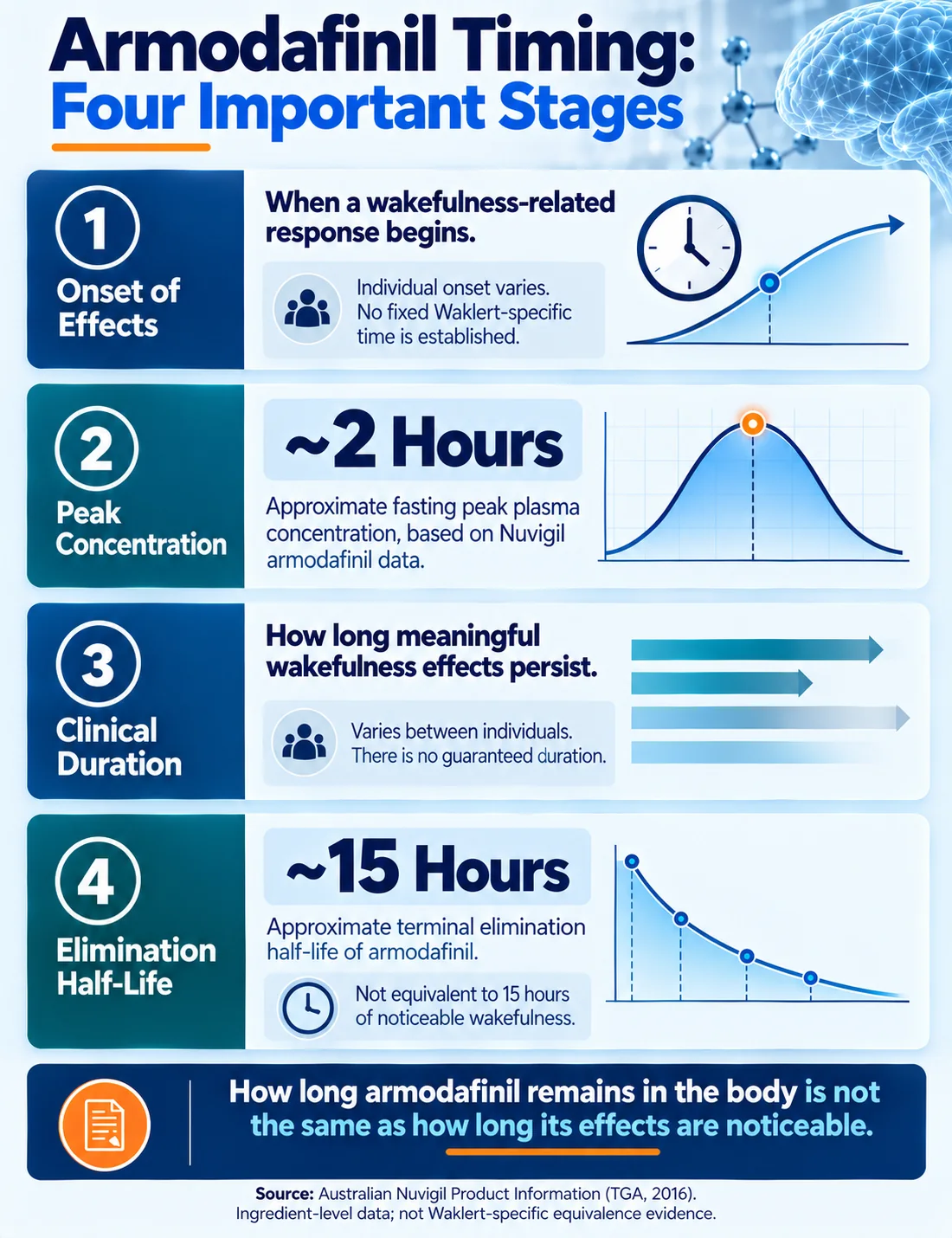
The Australian Nuvigil Product Information published with the TGA’s 2016 assessment reports that armodafinil reaches peak plasma concentrations at approximately two hours when taken in a fasted state.
This measurement comes from evidence involving Nuvigil rather than a dedicated Waklert pharmacokinetic study.
Peak concentration is not necessarily the moment of maximum alertness.
A person may notice effects before peak concentration, while wakefulness-related effects may continue as concentrations decline.
The following table explains the differences.
| Measurement | What it describes |
|---|---|
| Onset of effects | When a wakefulness-related response begins |
| Peak concentration | When the measured blood concentration reaches its maximum |
| Clinical duration | How long a meaningful wakefulness-related effect persists |
| Elimination half-life | How long concentration takes to fall by approximately half during terminal elimination |
| Residual exposure | Armodafinil remaining in the body after its strongest effects have passed |
These measurements are related, but none independently determines exactly how long Waklert will feel effective.
What Is the Half-Life of Waklert?
For readers asking how long does Waklert last, the elimination half-life of armodafinil is approximately 15 hours, according to the Australian Nuvigil Product Information published in 2016.
Because Waklert contains armodafinil, this ingredient-level evidence is relevant to understanding its expected elimination characteristics. However, the figure does not come from a dedicated Waklert clinical trial.
Half-life describes how a medicine’s concentration gradually decreases during elimination.
For example, assuming a 15-hour terminal half-life, approximately half of a reference concentration would remain after one half-life during the elimination phase.
After another 15 hours, approximately one-quarter would remain.
This is a simplified illustration. Actual concentrations depend on absorption, distribution, metabolism and individual physiology.
Crucially, armodafinil does not disappear from the body when its noticeable effects fade.
It may remain present for considerably longer than the period during which someone experiences a meaningful improvement in wakefulness.
Likewise, residual armodafinil does not guarantee that an individual will continue experiencing the same strength of effect.
Age, liver function and other medicines can also influence pharmacokinetics.
The approximately 15-hour figure describes a population-level pharmacokinetic finding, not an identical clearance pattern for everyone.
This explains why claims that Waklert lasts one fixed number of hours can be misleading.
What Factors Can Affect Waklert's Duration?
The answer to how long does Waklert last varies because several factors can influence how armodafinil is absorbed, processed or experienced. Some have documented pharmacokinetic effects, while others mainly influence how noticeable the response feels.
Individual Metabolism and Health
Armodafinil undergoes metabolism through several pathways, including processes involving the liver.
Individual differences in metabolic activity can influence how quickly the body processes and eliminates medicines.
Age is also relevant. Australian Nuvigil Product Information reports increased armodafinil exposure and reduced clearance in some older adults.
Liver impairment may also affect drug exposure. However, some supporting hepatic-impairment data come from modafinil studies rather than direct armodafinil investigations.
These findings do not allow a clinician to predict a specific additional number of hours of wakefulness from age or liver function alone.
An individual’s sleep disorder, accumulated sleep debt and response to treatment may also affect perceived duration.
Therefore, subjective wakefulness should not be treated as a precise measurement of armodafinil metabolism.
Food and Absorption
Food can influence the timing of armodafinil absorption.
According to the Australian Nuvigil clinical assessment, food can delay the time to peak plasma concentration by approximately two to four hours.
Overall systemic exposure is minimally affected, but the delayed peak may change the time course of pharmacological effects.
In other words, food may shift when armodafinil concentrations are highest without producing a comparable change in total drug exposure.
However, a delayed peak does not establish that Waklert produces stronger effects or guarantees additional hours of wakefulness.
These observations explain pharmacokinetics. They are not instructions to change food intake to manipulate a medicine’s effects.
People prescribed armodafinil should follow their clinician’s instructions.
Other Medicines and Medical Conditions
Armodafinil can interact with other medicines through its effects on drug-metabolising enzymes.
Australian Nuvigil Product Information describes interactions involving CYP3A4/5 and CYP2C19 pathways.
These interactions may alter exposure to certain medicines taken alongside armodafinil. They do not necessarily mean Waklert itself will last longer or shorter.
Hormonal contraceptives are particularly important because armodafinil may reduce their effectiveness. People using hormonal contraception should obtain professional advice about appropriate additional or alternative contraception.
Certain medical conditions can also affect the suitability and monitoring of armodafinil treatment.
People with liver disease, cardiovascular conditions or relevant psychiatric histories may require additional clinical assessment.
Ultimately, Waklert’s duration cannot be evaluated separately from a person’s medical history and other treatments.
Can Waklert Affect Sleep Later?
Yes. When assessing how long does Waklert last, sleep effects matter because armodafinil can interfere with sleep, and insomnia is a recognised adverse effect of medicines containing this active ingredient.
Because armodafinil has a relatively long elimination half-life, some medicine may remain in the bloodstream after the strongest perceived wakefulness effects have diminished.
This residual exposure may contribute to difficulty sleeping in some individuals.
However, the relationship is not perfectly predictable.
Two people with similar drug exposure may experience different levels of sleep disruption. Sleep patterns, underlying sleep disorders and individual sensitivity can all contribute.
It is important to distinguish between no longer feeling more alert and having no armodafinil remaining in the body.
Someone may feel tired while residual armodafinil is still present. Likewise, reduced alertness does not prove that the medicine has been eliminated.
Australian Nuvigil Consumer Medicine Information warns that taking the medicine later than recommended for certain sleep disorders may cause difficulty sleeping at night.
This reinforces the importance of following individual prescription instructions rather than assuming the medicine has stopped acting once the most noticeable effects fade.
Armodafinil does not replace adequate sleep or treatment of the underlying medical condition.
Is Waklert's Duration Different From Modafinil?
Waklert contains armodafinil, whereas modafinil medicines contain a mixture of two molecular forms called the R- and S-enantiomers.
Armodafinil contains only the R-enantiomer.
These molecular forms have different pharmacokinetic characteristics, especially their elimination rates.
Australian Nuvigil Product Information explains that the R-enantiomer has a substantially longer half-life than the S-enantiomer.
Consequently, armodafinil and modafinil can produce different blood concentration profiles over time.
However, a longer-lasting pharmacokinetic component does not automatically establish a proportionally longer period of clinical wakefulness.
The Product Information notes that the clinical implications of these pharmacokinetic differences remain uncertain.
Armodafinil and modafinil are not directly interchangeable on a milligram-for-milligram basis.
Therefore, it would be inaccurate to claim Waklert always lasts longer than every modafinil medicine or delivers superior wakefulness for everyone.
For a separate branded-product comparison, see Modvigil vs Waklert.
Waklert Timing and Safety Considerations
Understanding armodafinil’s duration is important for safe medical use, but general pharmacokinetic information cannot replace individual prescription instructions.
A clinician’s recommendations account for the medical condition, the patient’s health, other medicines and potential adverse effects.
Waklert 150mg describes the tablet’s stated active-ingredient strength. It does not establish the appropriate prescribed regimen for every individual.
Armodafinil may cause adverse effects, including headache, nausea, anxiety and insomnia.
Less common but potentially serious reactions include severe skin reactions, hypersensitivity reactions and significant psychiatric or cardiovascular symptoms.
Seek urgent medical attention for symptoms suggesting a serious allergic reaction or severe skin reaction, such as widespread rash, blistering, swelling or breathing difficulties.
A person should not independently change the amount or frequency of armodafinil use to compensate for an unexpectedly short or long perceived duration.
Similarly, persistent sleepiness does not automatically mean additional medication is appropriate.
If treatment appears ineffective or sleep disruption develops, clinical review is the appropriate next step.
Australian Prescription and Regulatory Context
In Australia, armodafinil is classified as a Schedule 4 (S4) prescription-only medicine.
This classification concerns the active ingredient’s legal scheduling and does not establish Australian registration for every overseas product containing it.
It is important to distinguish between three entities:
– Armodafinil: the active pharmaceutical ingredient responsible for wakefulness-promoting effects. – Nuvigil: a separately branded armodafinil medicine with Australian Product Information and ARTG registration. – Waklert: an overseas-branded armodafinil product whose Australian registration and evidence must be assessed separately.
The TGA’s ARTG entry for Nuvigil 150mg identifies registration number 226559.
The TGA also reported, in a 3 June 2021 enforcement announcement, that Waklert-branded tablets involved in an alleged unlawful importation were not included in the ARTG.
That historical finding does not by itself establish the registration status of every Waklert product in October 2026.
Nuvigil’s registration does not establish that Waklert is TGA-approved, registered, bioequivalent or therapeutically interchangeable.
Similarly, clinical findings for Nuvigil can provide relevant ingredient-level information but do not independently verify Waklert’s manufacturing quality or formulation equivalence.
Australian regulatory requirements must therefore be considered on a product-specific basis. The TGA also maintains separate rules for accessing unapproved therapeutic goods under specific pathways.
Frequently Asked Questions
Waklert 150mg contains armodafinil, which has an approximately 15-hour elimination half-life. However, noticeable wakefulness effects do not necessarily last 15 hours. Clinical duration varies, and no established Waklert-specific timeframe applies to everyone.
Armodafinil is absorbed after oral administration. Australian Nuvigil pharmacokinetic data show peak blood concentrations at approximately two hours when taken fasting. This does not establish exactly when an individual will first notice Waklert’s effects.
Armodafinil has an apparent terminal elimination half-life of approximately 15 hours. This describes how its concentration decreases during elimination, not the exact duration of clinical wakefulness.
Yes. Armodafinil can contribute to insomnia because residual drug exposure may continue after the strongest wakefulness effects have faded. Individual sensitivity and sleep patterns also influence the response.
Food can delay armodafinil’s peak blood concentration by approximately two to four hours, according to Australian Nuvigil clinical information. Overall exposure changes little, although the timing of effects may shift.
Armodafinil and modafinil have different pharmacokinetic profiles. Armodafinil contains the more slowly eliminated R-enantiomer, but this does not prove that Waklert produces longer clinical wakefulness for every individual.
Yes. Metabolism, age, medical conditions, food intake and concurrent medicines can influence armodafinil exposure or perceived effects. These factors do not allow an exact individual duration to be predicted.
Conclusion
Understanding how long does Waklert last requires distinguishing between several stages of armodafinil’s activity.
Australian clinical information for Nuvigil shows that armodafinil reaches peak blood concentrations at approximately two hours in a fasted state and has an elimination half-life of approximately 15 hours.
Food may delay peak concentration, while individual physiological and medical factors can influence drug exposure and response.
Neither peak concentration nor elimination half-life establishes an exact duration of noticeable wakefulness.
Armodafinil can remain in the body after its strongest perceived effects fade, potentially affecting sleep later. Equally, feeling tired does not necessarily mean it has been eliminated.
For Australian readers, evidence from registered armodafinil medicines does not automatically establish Waklert-specific bioequivalence or Australian regulatory approval.
Ultimately, Waklert’s clinical duration cannot reliably be reduced to one fixed number of hours. Ingredient-level pharmacokinetic evidence explains its expected behaviour, but individual prescription instructions and medical assessment remain essential.

ModvigilAUS Medical Editorial Team
ModvigilAUS Health Research Desk is the internal editorial team behind ModvigilAUS.com's educational content on Modafinil and Armodafinil. All articles are prepared using publicly available medical and scientific references, Australian regulatory guidance, and internal editorial review standards.
See all author post