- Your cart is empty
- Continue Shopping

Modvigil vs Waklert: Key Differences Explained
- Modafinil
- Posted on
-
by ModvigilAUS Medical Editorial Team
- 4 comments
Medical Disclaimer
This modvigil vs waklert comparison provides general educational information and is not personalised medical advice. Do not use it to self-prescribe, independently switch prescription medicines or calculate your own dose equivalence. Decisions involving prescription medicines require appropriate healthcare guidance.
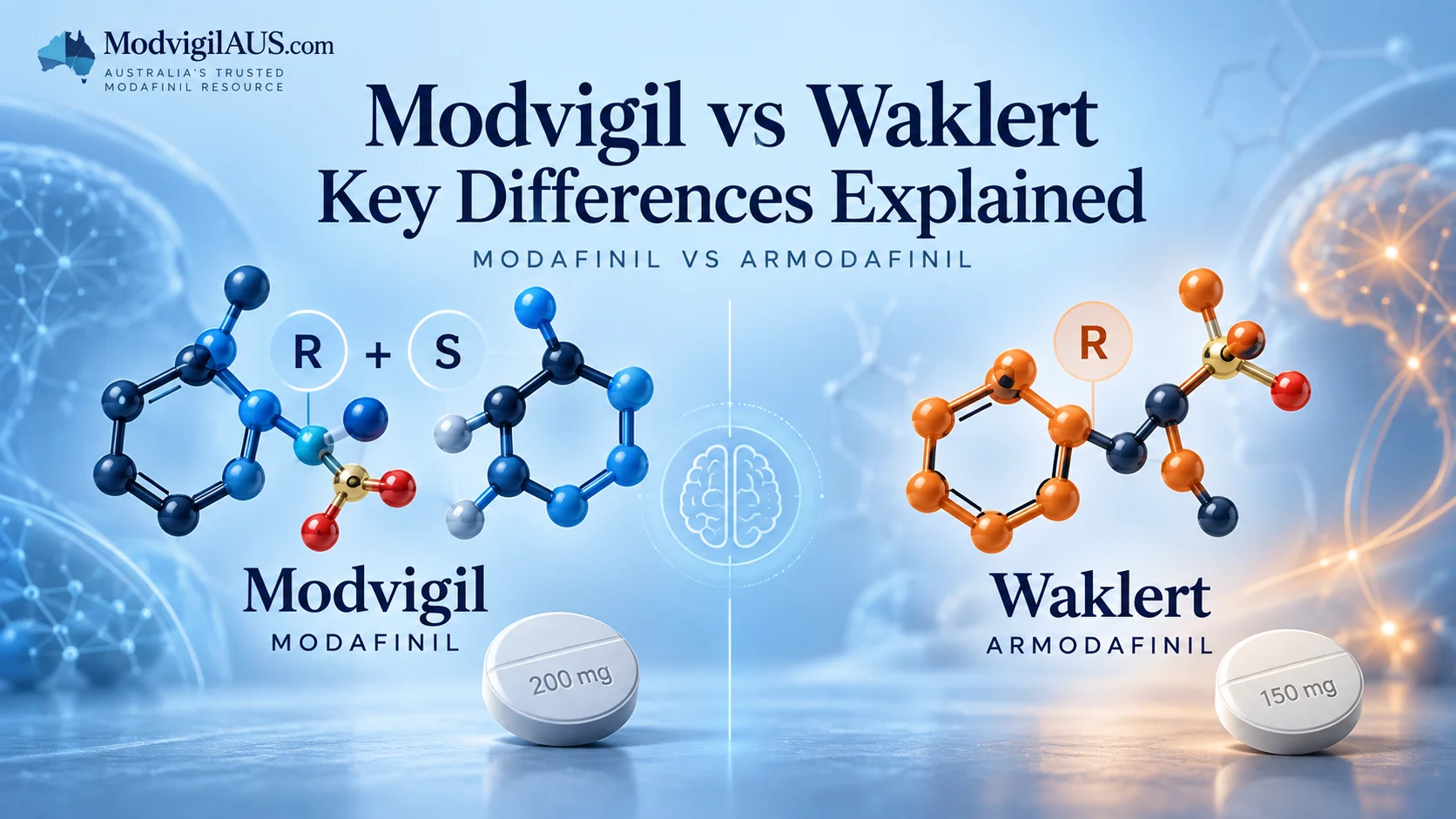
The central difference in modvigil vs waklert is the active ingredient: Modvigil is marketed as a modafinil product, while Waklert contains armodafinil. These medicines are closely related, but they are not identical. Modafinil contains both R- and S-enantiomers of the molecule, whereas armodafinil contains the R-enantiomer. That distinction matters when comparing tablet strengths, pharmacokinetics, duration, clinical evidence and safety.
A 200 mg modafinil tablet should not automatically be considered “stronger” than a 150 mg armodafinil tablet simply because its milligram number is higher. Likewise, research comparing modafinil with armodafinil does not automatically become evidence about the specific Modvigil and Waklert brands.
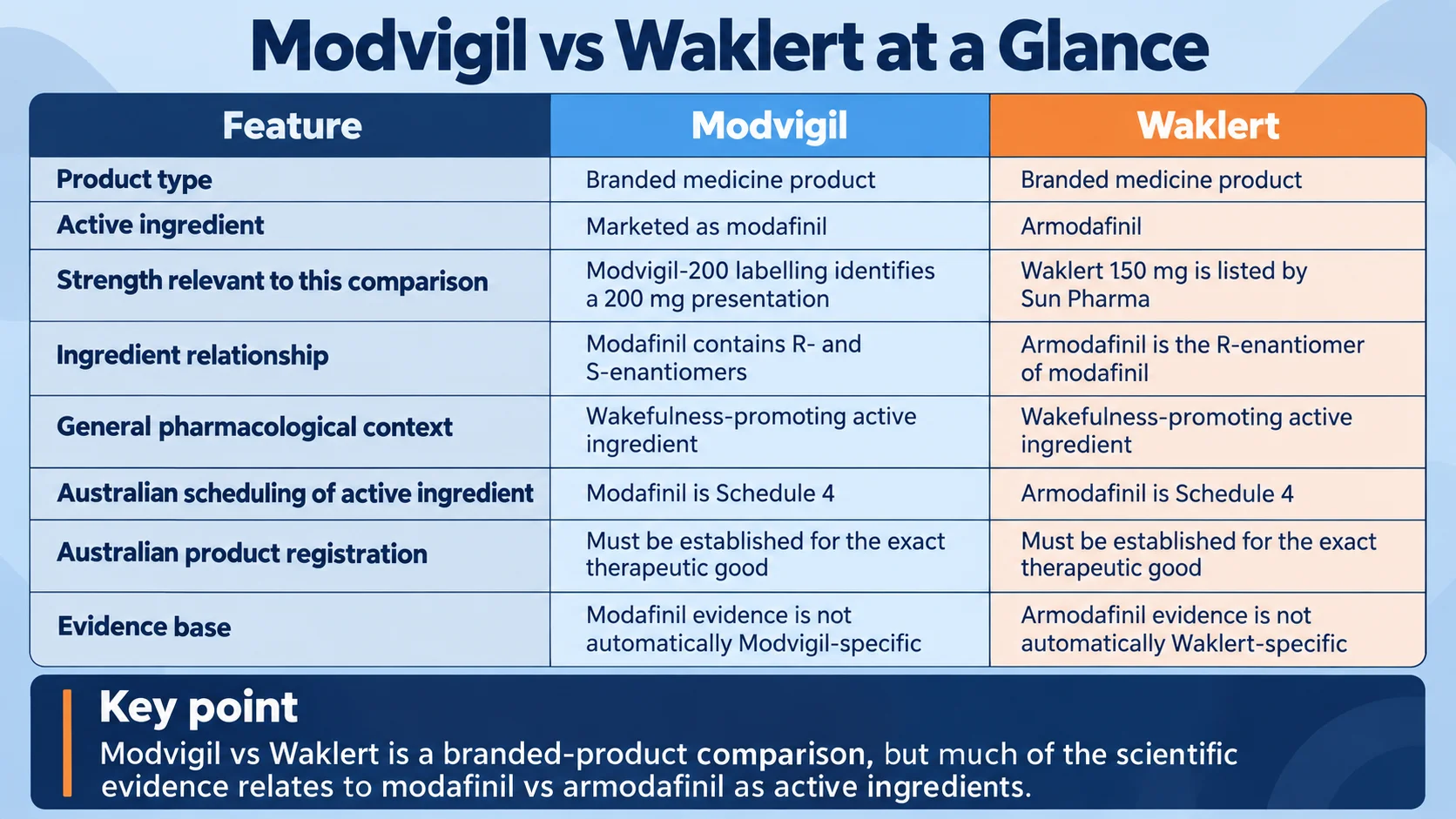
Modvigil vs Waklert at a Glance
Feature | Modvigil | Waklert |
Product type | Branded medicine product | Branded medicine product |
Active ingredient | Marketed as modafinil | Armodafinil |
Strength relevant to this comparison | Modvigil-200 labelling identifies a 200 mg presentation | Waklert 150 mg is listed by Sun Pharma |
Ingredient relationship | Modafinil contains R- and S-enantiomers | Armodafinil is the R-enantiomer of modafinil |
General pharmacological context | Wakefulness-promoting active ingredient | Wakefulness-promoting active ingredient |
Australian scheduling of active ingredient | Modafinil is Schedule 4 | Armodafinil is Schedule 4 |
Australian product registration | Must be established for the exact therapeutic good | Must be established for the exact therapeutic good |
Evidence base | Modafinil evidence is not automatically Modvigil-specific | Armodafinil evidence is not automatically Waklert-specific |

Indian government intellectual-property records associate the MODVIGIL-200 label with HAB Pharmaceuticals & Research Ltd, while available Modvigil-200 product labelling identifies the tablet as containing modafinil 200 mg. These are separate pieces of evidence: the intellectual-property record establishes the label association, while the product labelling supports the stated ingredient and strength.
Sun Pharmaceutical Industries currently lists Waklert 150 mg as an armodafinil tablet in its Indian product catalogue and also lists a 50 mg presentation.
In other words, modvigil vs waklert is a branded-product comparison whose scientific foundation includes the differences between modafinil and armodafinil. Keeping those two levels separate prevents ingredient-level research from being misrepresented as brand-specific evidence.
What Is the Main Difference Between Modvigil and Waklert?
The main difference is straightforward:
Modvigil → marketed as modafinil
Waklert → armodafinil
Australian regulatory documentation describes armodafinil as the R-enantiomer of modafinil and describes modafinil as a racemic mixture of the R- and S-enantiomers. Therefore, these active ingredients are closely related without being identical.
That chemical distinction can affect how drug concentrations change over time. However, it does not establish that either branded product is universally stronger, safer or clinically better.
This evidence boundary is particularly important when reading a modvigil vs waklert comparison. A clinical study of modafinil is evidence about modafinil under the conditions studied; it is not automatically a study of Modvigil. Likewise, research involving armodafinil or the separate NUVIGIL brand does not automatically establish a Waklert-specific effect. Broader Modvigil 200mg uses and effects should therefore be considered separately from this direct brand comparison.
Modafinil vs Armodafinil: How Are They Related?
Modafinil and armodafinil are closely related rather than belonging to completely separate drug families.
Modafinil is a racemic mixture. In plain English, it contains two mirror-image molecular forms, called the R- and S-enantiomers. Armodafinil contains the R-enantiomer. Australian regulatory assessment documents describe this relationship directly.
For readers wanting the separate product-versus-active-ingredient distinction, see Modvigil 200mg vs modafinil.
What Does “R-Enantiomer” Mean?
An enantiomer is one of two molecular forms that have the same basic chemical composition but differ in their three-dimensional arrangement.
A useful analogy is a pair of hands. Your left and right hands have corresponding parts, yet one cannot be perfectly placed over the other. Some molecules also occur in mirror-image forms.
For modafinil, those forms are commonly described as R-modafinil and S-modafinil. Armodafinil consists of the R form.
Why Does the Difference Matter?
The body does not handle the two modafinil enantiomers in exactly the same way. The S-enantiomer is eliminated more rapidly, while the R-enantiomer persists longer. Consequently, racemic modafinil and armodafinil can produce different concentration-time profiles.
Comparative pharmacokinetic research has found higher armodafinil plasma concentrations later in the dosing interval when researchers compared armodafinil and modafinil on a milligram-for-milligram basis. Importantly, this remains an active-ingredient finding. It does not prove that Waklert produces a stronger subjective effect than Modvigil.
Modvigil 200mg vs Waklert 150mg: Does the Strength Number Matter?
For modvigil vs waklert, the 200 mg and 150 mg labels matter, but they cannot be interpreted as a simple stronger-versus-weaker scale.
A milligram measures mass. It does not provide a universal measure of clinical potency between different active ingredients. Therefore, comparing 200 mg with 150 mg makes sense only after considering what substance each number measures.
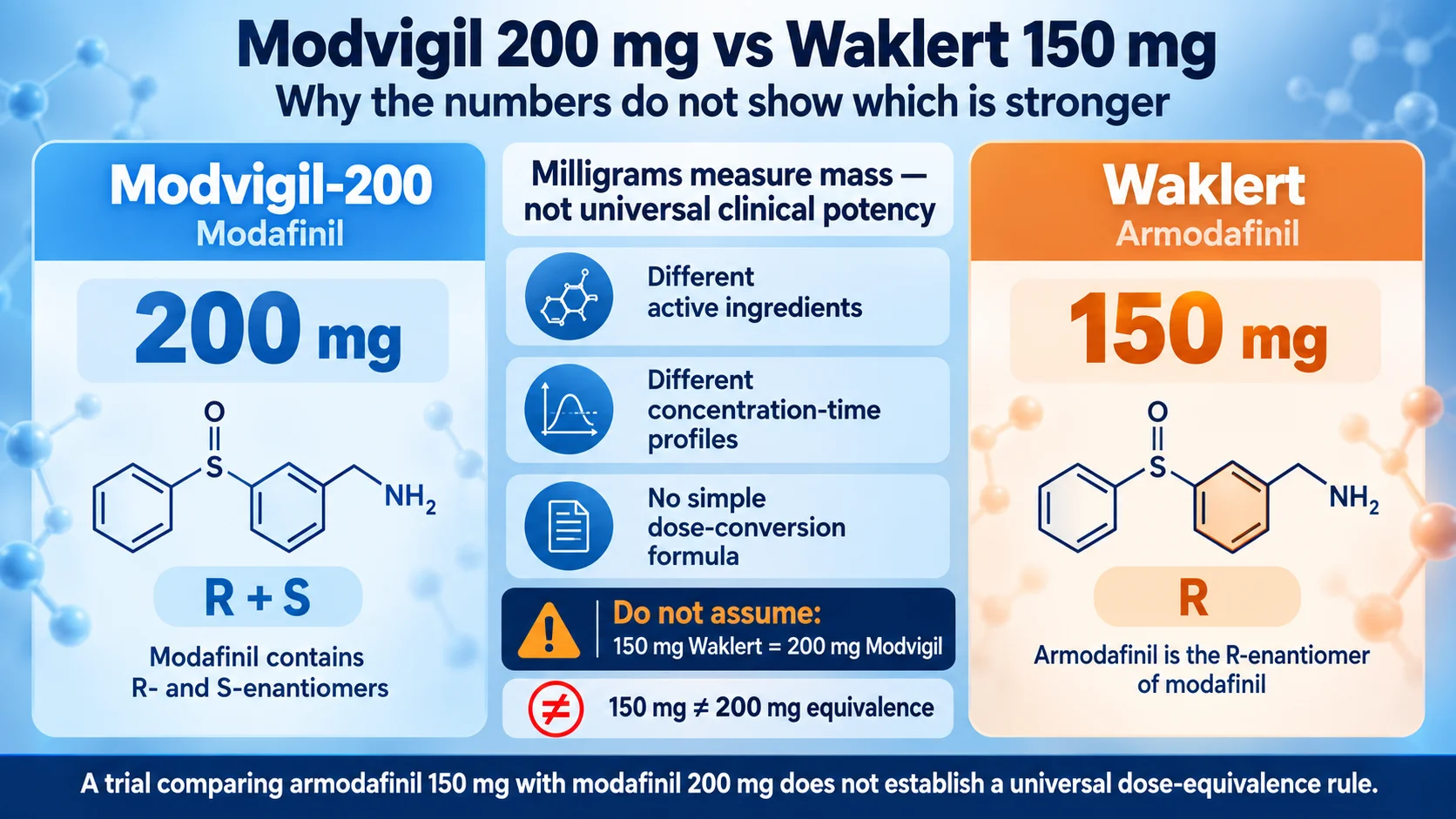

Modafinil contains both R- and S-enantiomers, while armodafinil contains the R-enantiomer. Their pharmacokinetic profiles also differ. For these reasons, the labels 200 mg and 150 mg do not establish a straightforward potency relationship.
Most importantly, they do not create a safe conversion formula.
The existence of Modvigil-200 and Waklert 150 mg presentations does not establish that:
150 mg Waklert = 200 mg Modvigil.
One randomised clinical trial comparing armodafinil 150 mg with modafinil 200 mg in people with shift work sleep disorder found that both groups improved from baseline and did not demonstrate a statistically significant efficacy difference between those regimens. However, a single comparison of those doses does not create a general clinical equivalence rule or justify self-directed switching.
Modvigil vs Waklert: How Long Can Their Effects Last?
A useful modvigil vs waklert duration discussion needs to distinguish pharmacokinetics from the length of time an individual subjectively notices an effect.
Elimination half-life describes how long it takes the body’s concentration of a medicine to fall by half during its elimination phase.
Subjective duration describes how long an individual perceives an effect.
They are not the same measurement.
One pooled analysis of three single-dose pharmacokinetic studies reported mean terminal elimination half-lives of approximately 13 hours for both armodafinil and modafinil after dose normalisation. However, the researchers also found different concentration-time profiles because the S-enantiomer in racemic modafinil declined more rapidly.
A separate steady-state analysis found higher dose-normalised armodafinil plasma concentrations later in the dosing interval, with the largest differences occurring later in the day.
These findings should not be converted into a claim that Waklert always lasts a fixed number of hours longer than Modvigil. Plasma concentration, terminal half-life and subjective duration are different concepts, and individual experience is not determined by pharmacokinetic measurements alone.
Does Waklert Feel Stronger Than Modvigil?
In a modvigil vs waklert comparison, “stronger” is not a precise medical endpoint.
Someone using that word might mean:
- a higher milligram number;
- a more noticeable subjective effect;
- greater measured wakefulness;
- higher plasma concentrations later in the day; or
- an effect that seems to persist for longer.
Those are different questions.
Research supports genuine pharmacokinetic differences between armodafinil and racemic modafinil. For example, a steady-state analysis found higher armodafinil concentrations later in the day when the two active ingredients were compared on a milligram-normalised basis.
However, higher plasma concentrations do not automatically mean a stronger subjective experience. Nor do they prove that one branded product is clinically superior.
Therefore, a broad claim that “Waklert is stronger than Modvigil” goes beyond what ingredient-level pharmacokinetic evidence can establish.
Modvigil vs Waklert for Wakefulness
The modvigil vs waklert question often includes wakefulness, but the available clinical evidence must remain tied to the active ingredients and populations actually studied.
Both modafinil and armodafinil have evidence as wakefulness-promoting medicines in defined medical settings. A systematic review and meta-analysis of randomised trials in adults with residual excessive sleepiness associated with obstructive sleep apnoea found improvements in subjective and objective sleepiness measures with modafinil or armodafinil compared with placebo.
Direct comparative evidence is more limited. In the 12-week randomised trial mentioned earlier, 211 people with shift work sleep disorder received either armodafinil 150 mg or modafinil 200 mg. The researchers reported improvement in both groups and did not demonstrate a significant difference in efficacy between those regimens.
That study should be described as armodafinil 150 mg versus modafinil 200 mg, not as a Modvigil-versus-Waklert trial unless the exact branded products are established as the products evaluated.
Accordingly, clinical evidence supports wakefulness-promoting effects for both active ingredients in relevant populations. It does not establish a universal brand-level winner or a dose-conversion rule.
Do Modvigil and Waklert Have Different Side Effects?
For modvigil vs waklert, the key safety point is that chemical relatedness creates overlapping considerations without proving identical safety profiles.
Australian armodafinil medicine information includes recognised adverse effects such as headache and nausea, as well as precautions, interactions and warnings that require medicine-specific interpretation. Modafinil also has its own prescribing and safety information.
This comparison does not need an exhaustive adverse-effect catalogue. The important distinction is that safety information should remain tied to the active ingredient and relevant product information rather than being transferred automatically from one branded medicine to another.
There is also no sufficient basis for claiming broadly that Modvigil is safer than Waklert or that Waklert is safer than Modvigil.
For more detailed modafinil safety context, see Modvigil 200mg side effects.
Are Modvigil and Waklert Interchangeable?
Modvigil and Waklert should not be treated as automatically interchangeable.
That is an important boundary in modvigil vs waklert because the products are associated with different active ingredients. Modafinil and armodafinil are closely related, but they are not identical medicines.
Their concentration-time profiles also differ, and the commonly discussed tablet strengths do not create a simple equivalence.
In addition, prescription decisions can involve the condition being treated, contraindications, medicine interactions, other treatments and individual response.
For these reasons, readers should not derive a conversion ratio, calculate an equivalent tablet amount or independently switch between the products.
What Australian Readers Should Know About Modvigil vs Waklert
For Australian readers, modvigil vs waklert requires two regulatory concepts to remain separate: the schedule of the active ingredient and the ARTG status of the exact therapeutic good.
The current Australian Poisons Standard places both armodafinil and modafinil within the Schedule 4 prescription-only framework. The TGA also describes both modafinil and armodafinil as Schedule 4 prescription-only medicines.
However, Schedule 4 status does not establish that a particular branded product appears in the Australian Register of Therapeutic Goods.
Current TGA records identify MODAVIGIL modafinil 100 mg as an ARTG-listed medicine. They also identify separate NUVIGIL armodafinil products, including 50 mg, 150 mg and 250 mg presentations.
MODAVIGIL is not Modvigil.
NUVIGIL is not Waklert.
The similarity of the names, or the presence of the same active ingredient, does not make the products identical for regulatory purposes.
The TGA also reported in a June 2021 enforcement notice that tablets branded Waklert involved in that particular importation matter were not included in the ARTG at that time. That historical statement should not be treated as proof of Waklert’s current registration status; current status requires checking the current ARTG.
Likewise, the current ARTG entry for MODAVIGIL does not establish registration of Modvigil. Scheduling applies to substances, while ARTG entries relate to specific therapeutic goods.
Modvigil vs Waklert Which Is Better?
The available evidence does not support turning modvigil vs waklert into a universal “better product” conclusion.
Different questions produce different kinds of evidence.
For molecular composition, modafinil contains R- and S-enantiomers, whereas armodafinil contains the R-enantiomer.
For pharmacokinetics, comparative studies show different concentration-time profiles, particularly later in the dosing interval.
For wakefulness, both active ingredients have clinical evidence from defined medical populations.
For safety, each medicine requires appropriate prescribing information and individual clinical consideration.
For tablet strength, 200 mg versus 150 mg does not establish a winner because the numbers refer to different active ingredients.
Price, online reviews and subjective claims of “strength” cannot establish medical suitability either. The useful role of this comparison is therefore to clarify the evidence rather than choose a prescription medicine for an individual.
For broader product-specific context about Waklert rather than a direct comparison, see Waklert 150mg Australia reviews.
Key Differences Between Modvigil and Waklert
The later-stage modvigil vs waklert comparison can be summarised without collapsing product-level facts into ingredient-level evidence.
Active ingredient:
Modvigil-200 product labelling identifies modafinil 200 mg, while Sun Pharma lists Waklert 150 mg as containing armodafinil 150 mg. Indian intellectual-property records separately associate the MODVIGIL-200 label with HAB Pharmaceuticals & Research Ltd.
Ingredient relationship:
Modafinil is a racemic mixture containing R- and S-enantiomers. Armodafinil is the R-enantiomer of modafinil.
Tablet strength:
The commonly encountered comparison is Modvigil 200 mg versus Waklert 150 mg, but those different numbers do not establish which product is clinically stronger.
Pharmacokinetics:
Armodafinil and modafinil have different concentration-time profiles. Comparative research found higher later-day armodafinil plasma concentrations under defined study conditions.
Clinical evidence:
Both active ingredients have evidence relating to wakefulness in defined medical populations. Ingredient-level evidence, however, is not automatically evidence about the Modvigil and Waklert brands.
Safety:
The active ingredients share some safety considerations, but their safety information should not be assumed to be identical.
Interchangeability:
Modafinil and armodafinil are distinct active ingredients, and the numerical tablet strengths do not provide a simple self-directed conversion formula.
Australian status:
Both active ingredients are currently Schedule 4. ARTG registration remains product-specific.
Frequently Asked Questions
What is the main difference between Modvigil and Waklert?
Modvigil is marketed as a modafinil product, whereas Waklert contains armodafinil. Modafinil contains both R- and S-enantiomers, while armodafinil consists of the R-enantiomer. They are closely related but distinct active ingredients.
Is Waklert stronger than Modvigil?
There is no sound basis for stating universally that Waklert is stronger. In a modvigil vs waklert comparison, “strength” could mean milligram quantity, subjective intensity, measured wakefulness, later-day plasma concentration or perceived duration. Those are not the same endpoints. Pharmacokinetic studies show differences between armodafinil and modafinil, but they do not prove universal brand-level superiority.
Is armodafinil the same as modafinil?
No. Armodafinil is the R-enantiomer of modafinil, while modafinil is a racemic mixture containing R- and S-enantiomers. Therefore, they are closely related but not identical.
Does Waklert last longer than Modvigil?
Ingredient-level studies show that armodafinil can maintain higher plasma concentrations later in a dosing interval than modafinil under certain study conditions. However, this does not establish a fixed difference in how many hours Waklert and Modvigil will subjectively affect every individual. Plasma concentration and perceived duration are separate measurements.
Is Waklert 150mg equivalent to Modvigil 200mg?
No general equivalence should be assumed. The two strengths refer to different active ingredients. Although one trial directly compared armodafinil 150 mg with modafinil 200 mg, that study does not establish a general conversion formula or make the two strengths automatically interchangeable.
Can Modvigil and Waklert be used interchangeably?
They should not be treated as automatically interchangeable. Modafinil and armodafinil differ in composition and pharmacokinetic profile, while tablet strength alone cannot establish an equivalent regimen. Prescription changes require appropriate healthcare guidance.
Are Modvigil and Waklert registered in Australia?
The regulatory question in modvigil vs waklert must be answered product by product. Current ARTG records confirm separate products such as MODAVIGIL and NUVIGIL, but those registrations cannot be transferred to Modvigil or Waklert simply because the names or active ingredients are related. The TGA’s 2021 Waklert statement concerned tablets involved in that matter at that time and should not be treated as proof of current registration status.
Conclusion
The central lesson from modvigil vs waklert is that these are separate branded products associated with closely related but distinct active ingredients. Modvigil is marketed as modafinil, whereas Waklert contains armodafinil. Modafinil contains R- and S-enantiomers; armodafinil contains the R-enantiomer.
That difference means 200 mg versus 150 mg is not a simple potency comparison. Pharmacokinetic research also identifies meaningful differences between armodafinil and modafinil, particularly in later-day plasma concentrations, but those findings do not prove that one branded product is universally stronger, longer-lasting or clinically superior.
For Australians, both active ingredients are Schedule 4, while ARTG registration remains specific to the exact therapeutic good. MODAVIGIL cannot be treated as Modvigil, and NUVIGIL cannot be treated as Waklert for regulatory purposes.
Ultimately, this comparison can explain the product, ingredient and regulatory differences. It cannot determine an individual’s medical suitability or replace healthcare guidance about prescription medicines.

ModvigilAUS Medical Editorial Team
ModvigilAUS Health Research Desk is the internal editorial team behind ModvigilAUS.com's educational content on Modafinil and Armodafinil. All articles are prepared using publicly available medical and scientific references, Australian regulatory guidance, and internal editorial review standards.
See all author post
4 Comments