- Your cart is empty
- Continue Shopping

Modvigil 200mg vs Modafinil: Is There a Real Difference?
- Modafinil
- Posted on
-
by ModvigilAUS Medical Editorial Team
- 10 comments
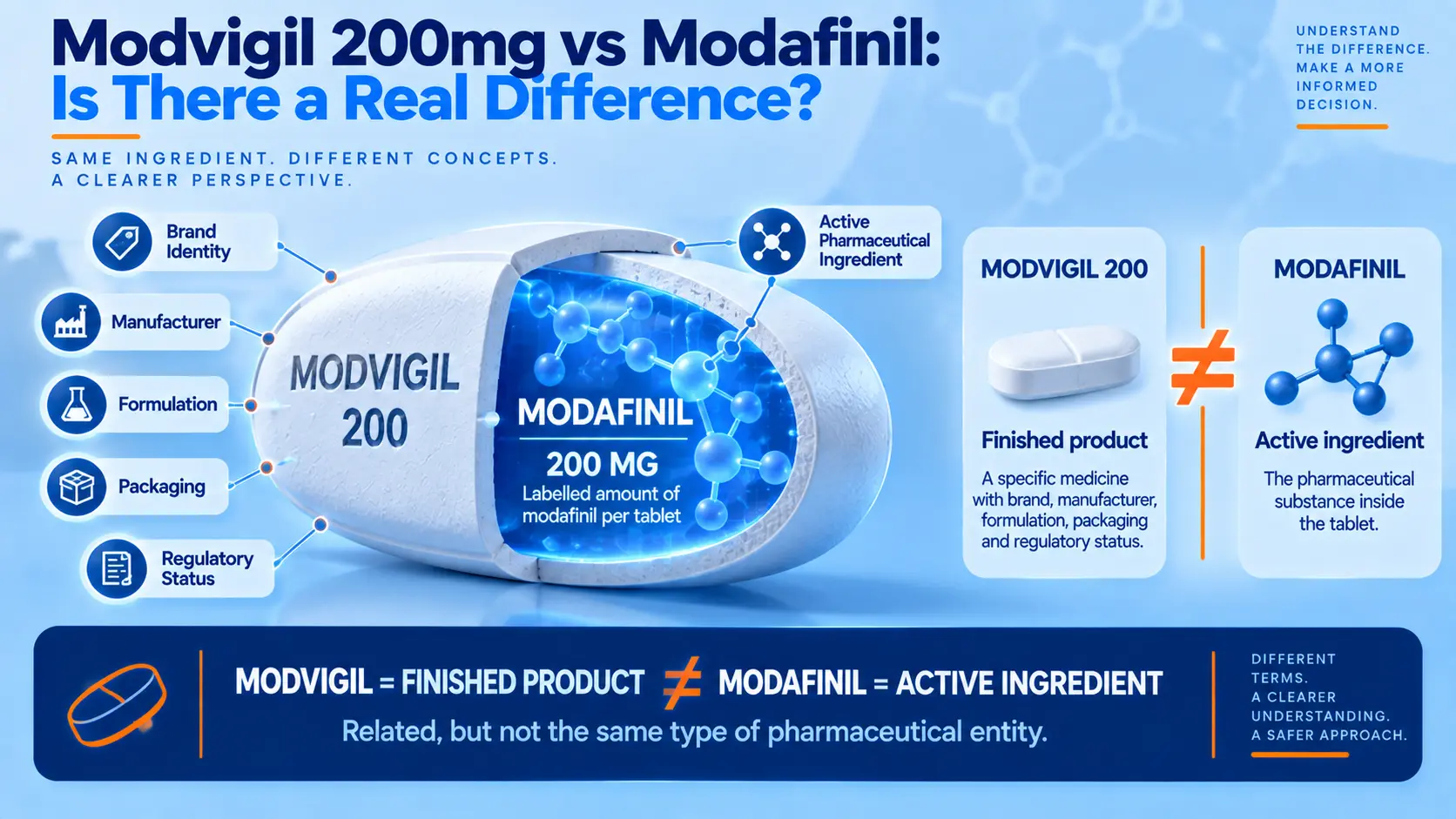
The key to understanding modvigil 200mg vs modafinil is
recognising that the two terms describe different pharmaceutical entities.
Modvigil 200 is a branded finished tablet product identified as
containing modafinil 200 mg.
Modafinil is the active pharmaceutical ingredient.
The 200 mg figure is the labelled amount of modafinil in the tablet.
So, this is not fundamentally a comparison between two unrelated active substances.
However, saying that Modvigil and modafinil are “exactly the same” would
also be misleading. A finished medicine has its own product identity and
may have product-specific characteristics such as its manufacturer,
formulation, excipients, packaging and regulatory history. Modafinil, by
contrast, is the pharmacologically active substance used in multiple
finished medicines.
For Australian readers, another distinction matters:
modafinil’s Australian scheduling status does not establish the
ARTG registration status of Modvigil or any other individual brand.
The real difference is therefore straightforward:
Modvigil is a finished branded product; modafinil is the active
ingredient it is identified as containing.
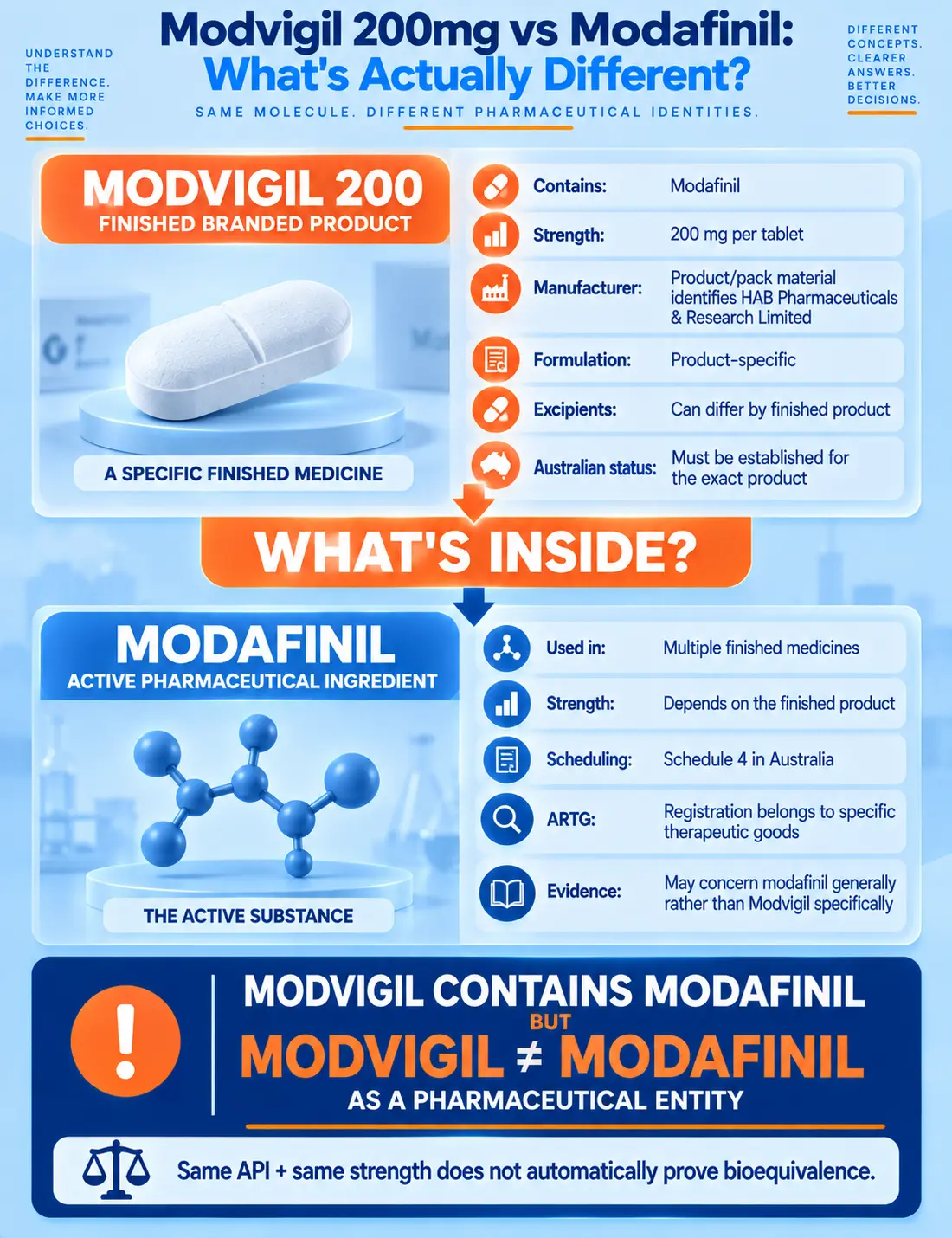
Modvigil 200mg vs Modafinil: The Short Answer
The relationship can be summarised in three lines:
Modvigil 200 = branded finished tablet product
Modafinil = active pharmaceutical ingredient
200 mg = labelled amount of modafinil per Modvigil 200 tablet
Product/pack information reviewed for Modvigil 200 identifies the medicine as “Modafinil Tablets USP” and states that each tablet contains modafinil USP 200 mg. The same material identifies HAB Pharmaceuticals & Research Limited as the manufacturer.
This product-level evidence supports the Modvigil–modafinil relationship. However, it should not be confused with Australian TGA-approved Product Information for an ARTG-registered medicine.
Consequently, Modvigil vs modafinil is not the same type of comparison as comparing two different active ingredients.
At the same time, the terms are not interchangeable pharmaceutical entities. Modafinil describes an ingredient; Modvigil identifies a particular finished product containing that ingredient.
What Is Modafinil?
Modafinil is an active pharmaceutical ingredient, or
API, used in prescription medicines.
An API is the substance responsible for a medicine’s intended
pharmacological activity. A finished medicine combines its active
ingredient with the other components needed to produce the dosage form.
Therefore, modafinil is not one particular brand.
Australian ARTG records illustrate this clearly. For example, current
records identify APO-MODAFINIL modafinil 100 mg tablet blister
pack and MODAFINIL-WGR modafinil 100 mg tablet blister
pack as separate registered therapeutic goods. Each has its own
ARTG entry and sponsor.
Those examples establish a useful principle: one active ingredient
can appear in multiple separately identified finished medicines.
They do not establish anything about Modvigil’s own ARTG status.
In Australia, the TGA identifies modafinil as a Schedule 4
Prescription Only Medicine. That is an ingredient-level
scheduling classification and should remain separate from product-specific
ARTG registration.
For this comparison, modafinil’s role as the active ingredient is the key
point. Detailed uses and effects of Modvigil 200mg and Modvigil 200mg side effects belong to other articles in the Modvigil cluster.
What Is Modvigil 200mg?
Modvigil 200 is a branded finished tablet product.
The product/pack material reviewed identifies:
- Product:
Modvigil-200 - Active ingredient:
modafinil - Labelled strength:
200 mg - Dosage form:
tablet - Manufacturer identified on the material:
HAB Pharmaceuticals & Research Limited
The product material also describes the dosage form as an uncoated
tablet. However, because this is not Australian TGA-approved Product
Information for Modvigil, tablet is the more appropriate
description for the purposes of this Australian article.
The 200 mg figure has a specific meaning: it is the labelled quantity of
modafinil per tablet.
It does not mean that Modvigil contains a separate substance called
“200 mg”, nor does the number prove that the product is better, stronger
in a clinical sense, or equivalent to every other medicine containing
the same amount of modafinil.
Likewise, identifying modafinil 200 mg on Modvigil product material does
not establish Australian ARTG registration.
Is Modvigil the Same as Modafinil?
No—not as pharmaceutical entities. Modvigil contains modafinil,
but Modvigil is the finished branded product and modafinil is its active
ingredient.
This distinction explains why both statements can be accurate:
Modvigil 200 contains modafinil.
Modvigil 200 and modafinil are not interchangeable product names.
Using “modafinil” informally to describe Modvigil may communicate which
active ingredient it contains, but it leaves out product-specific
information.
The distinction becomes especially important when interpreting clinical
studies and regulatory documents.
A study investigating modafinil can provide evidence about the active
ingredient without necessarily being a study of the Modvigil finished product.
Similarly, Australian Product Information issued for another registered
modafinil medicine belongs to that medicine. It should not automatically
be described as Modvigil’s Product Information.
The same rule applies to ARTG entries: another modafinil
medicine’s registration does not transfer to Modvigil.
What Can Differ Between Modvigil and Other Modafinil Products?
Medicines can share an active ingredient while remaining distinct finished products.
These differences do not automatically make one product clinically better or worse. Rather, they show why identifying the API alone does not completely describe a medicine.
Manufacturer
Manufacturer information belongs to the finished product, not to modafinil as an abstract active ingredient.
The Modvigil 200 product/pack material reviewed identifies HAB Pharmaceuticals & Research Limited as the manufacturer.
Other modafinil-containing medicines can have different manufacturers and Australian sponsors. Therefore, manufacturer identity should remain product-specific.
Excipients and Formulation
A finished tablet contains more than its active ingredient.
It can also contain excipients, which are other ingredients used to create the finished dosage form. Different products containing the same API can have different formulations or excipient profiles.
This article does not assign a specific excipient profile to Modvigil because sufficiently authoritative product-specific evidence was not established for that level of detail.
More importantly, the possibility of formulation differences should not be turned into an unsupported clinical claim. Different excipients do not, by themselves, prove that one product works better, worse, faster or longer than another.
Tablet Appearance and Packaging
Finished medicines may also differ in tablet appearance, blister presentation, labelling and packaging.
Those characteristics can help identify a particular finished product. However, appearance alone does not establish clinical equivalence, regulatory status or authenticity.
The relevant point for modvigil 200mg vs modafinil is simply that packaging and presentation belong to a finished product, whereas “modafinil” names the active ingredient.
Product-Specific Regulatory Status
Finished medicines have product-specific regulatory records.
In Australia, the ARTG identifies individual therapeutic goods. A
modafinil-containing medicine may have its own product name, ARTG number
and sponsor.
As a result, registration of one modafinil product cannot simply be
transferred to another brand.
Registration in Different Countries
Regulatory status is also jurisdiction-specific.
A product’s status overseas does not automatically determine its
Australian status. Similarly, the fact that a medicine contains an
ingredient used in Australian registered products does not itself
establish an ARTG entry for that finished medicine.
Any regulatory claim should therefore identify both the
specific product and the
relevant jurisdiction.
Does the Same Active Ingredient Mean the Same Effect?
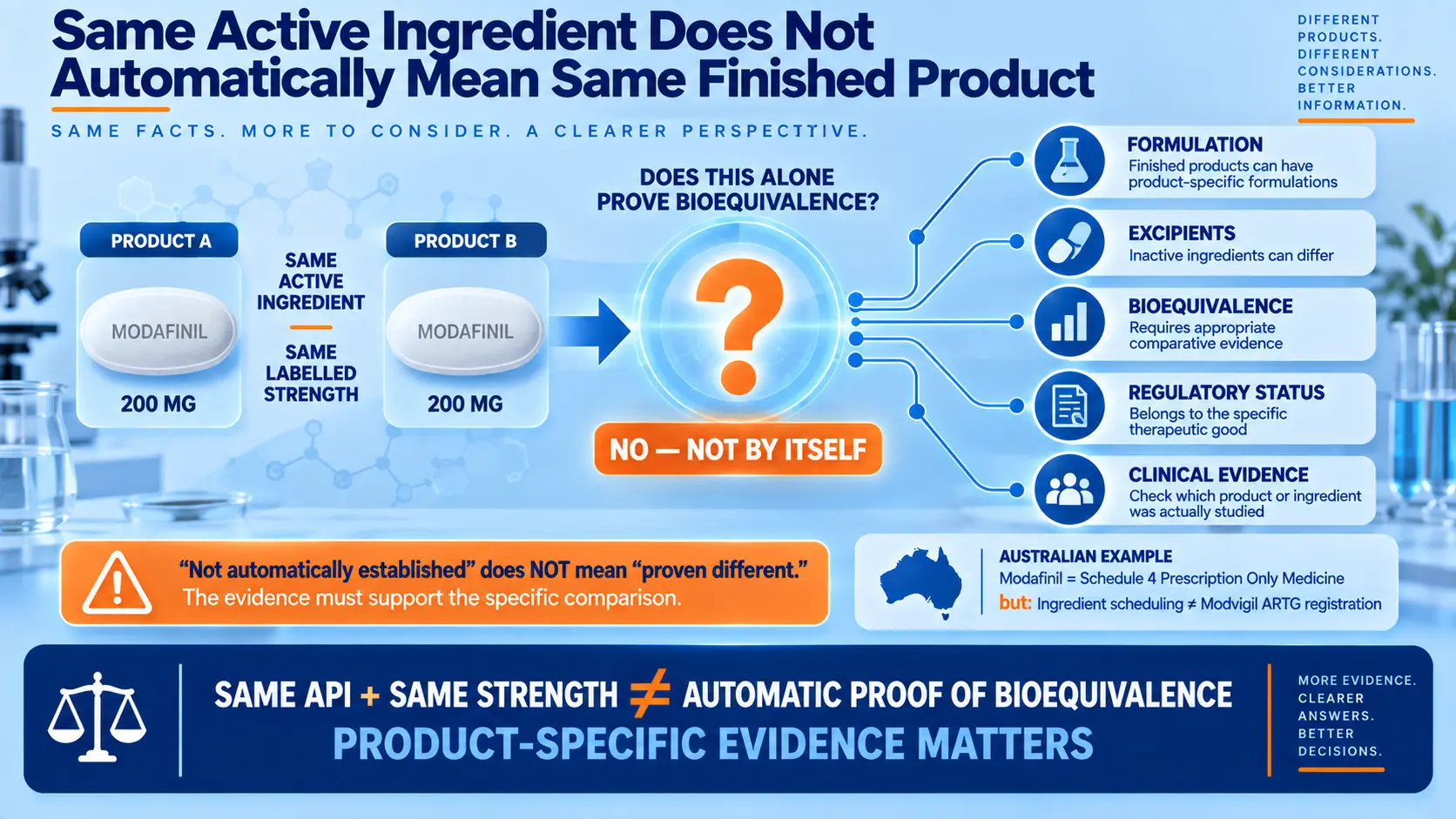
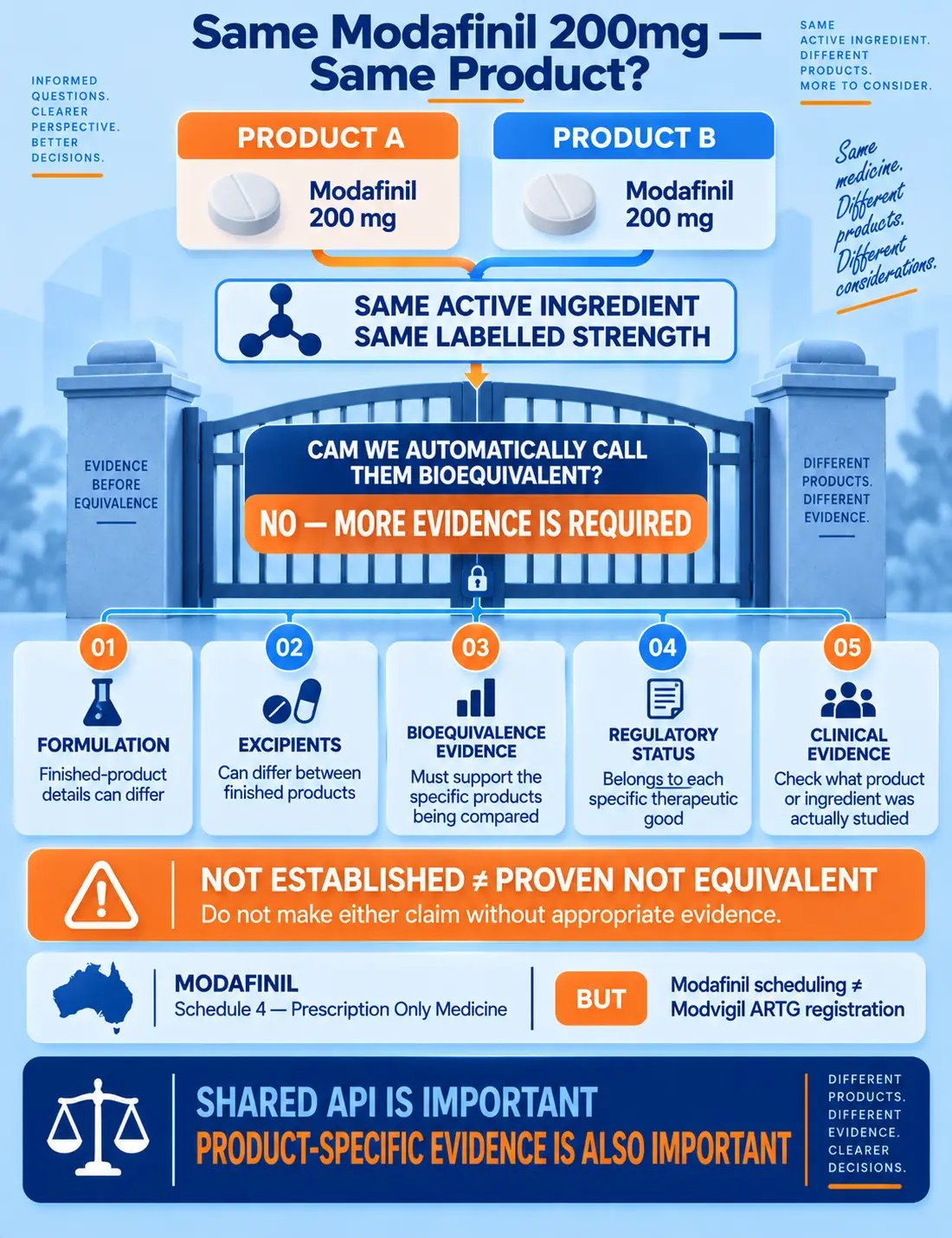
Sharing an active ingredient is important, but
the same active ingredient and labelled strength do not, by
themselves, establish bioequivalence between two finished medicines.
The TGA explains that generic prescription medicines contain the same
active ingredient as the existing medicine but must also be
bioequivalent. In practical terms, bioequivalence assesses
whether comparable amounts of the active ingredient are absorbed over a
comparable period under specified conditions.
Therefore:
Same API + same labelled strength
≠
automatically proven bioequivalence.
That distinction matters when comparing Modvigil with another finished modafinil medicine.
This article does not claim that Modvigil 200 has been shown to be
bioequivalent to a particular Australian ARTG-registered modafinil
product. Nor does the absence of product-specific evidence reviewed here
prove that Modvigil is not bioequivalent.
The appropriate conclusion is narrower:
Modvigil 200 is identified as containing modafinil 200 mg, but
that fact alone does not establish bioequivalence or identical clinical
performance with every other modafinil 200 mg product.
Modvigil, Modafinil and Australian Regulation
Australian regulation makes the product-versus-ingredient distinction particularly important.
Several concepts need to remain separate.
Scheduling
Scheduling is Australia’s national classification system controlling how medicines and chemicals are made available.
The TGA identifies Schedule 4 as Prescription Only Medicine for human medicines, and specifically describes modafinil as a Schedule 4 prescription-only medicine.
That classification applies to modafinil. It does not constitute an ARTG entry for every product containing modafinil.
ARTG Registration
The Australian Register of Therapeutic Goods contains individual therapeutic goods that have been entered in the register.
Current ARTG records identify multiple registered modafinil-containing medicines. For example, APO-MODAFINIL and MODAFINIL-WGR have their own ARTG records, product names and sponsors.
Those registrations belong to those specific products.
They do not establish Modvigil’s registration.
What About Modvigil’s ARTG Status?
The current authoritative Australian records reviewed for this article establish active ARTG entries for other identifiable modafinil medicines. I did not identify an authoritative current ARTG entry for the exact Modvigil product in the records reviewed.
That wording is deliberate.
It should not be converted into the broader claim that “Modvigil is definitely not registered in Australia” unless authoritative evidence establishes that conclusion.
Likewise, Modvigil should not be described as “TGA approved” or “ARTG registered” based merely on modafinil’s Schedule 4 classification or another modafinil medicine’s registration.
The reliable entity rule is:
Modafinil Schedule 4 status ≠ Modvigil ARTG registration
and:
Another modafinil product’s ARTG entry ≠ Modvigil ARTG registration
Why the Brand-vs-Ingredient Distinction Matters
Understanding the difference between Modvigil and modafinil prevents several common errors.
-
01
First, it helps readers interpret clinical evidence correctly. A study of modafinil is evidence about the active ingredient or the product actually studied; it is not automatically a Modvigil-specific study.
-
02
Second, it prevents Product Information from being transferred between brands. Australian PI for one registered modafinil medicine belongs to that therapeutic good.
-
03
Third, it improves comparisons between medicines. Two finished tablets may list the same API and strength while remaining separate pharmaceutical products.
-
04
Fourth, it prevents inaccurate regulatory statements. “Modafinil is a Schedule 4 medicine in Australia” does not mean “every modafinil brand is ARTG registered”.
-
05
Finally, it clarifies what the 200 mg label means. For Modvigil 200, the available product material identifies it as the amount of modafinil per tablet. The number does not establish that every 200 mg modafinil product is otherwise identical.
Modvigil 200mg vs Modafinil — Comparison Table
| Feature | Modvigil 200mg | Modafinil |
|---|---|---|
| Entity type | Modvigil 200mg Branded finished tablet product | Modafinil Active pharmaceutical ingredient |
| Relationship | Modvigil 200mg Identified as containing modafinil | Modafinil Active ingredient used in multiple finished medicines |
| 200 mg meaning | Modvigil 200mg Labelled amount of modafinil per tablet | Modafinil A strength only when specified for a particular finished product |
| Manufacturer | Modvigil 200mg Product/pack material reviewed identifies HAB Pharmaceuticals & Research Limited | Modafinil The API itself is not a branded finished medicine with one universal product manufacturer |
| Formulation | Modvigil 200mg Product-specific finished formulation | Modafinil Active ingredient rather than a complete tablet formulation |
| Excipients | Modvigil 200mg Can form part of the finished product formulation | Modafinil Not defined by the term “modafinil” alone |
| Australian scheduling | Modvigil 200mg Does not itself establish product registration | Modafinil Modafinil is Schedule 4 in Australia |
| ARTG status | Modvigil 200mg Must be established for the exact Modvigil therapeutic good | Modafinil ARTG entries belong to specific finished therapeutic goods |
| Clinical evidence | Modvigil 200mg Must be checked to determine whether it genuinely studied Modvigil | Modafinil Studies may investigate modafinil generally or particular modafinil medicines |
| Bioequivalence | Modvigil 200mg Cannot be assumed from API and strength alone | Modafinil Shared API does not itself prove two finished products are bioequivalent |
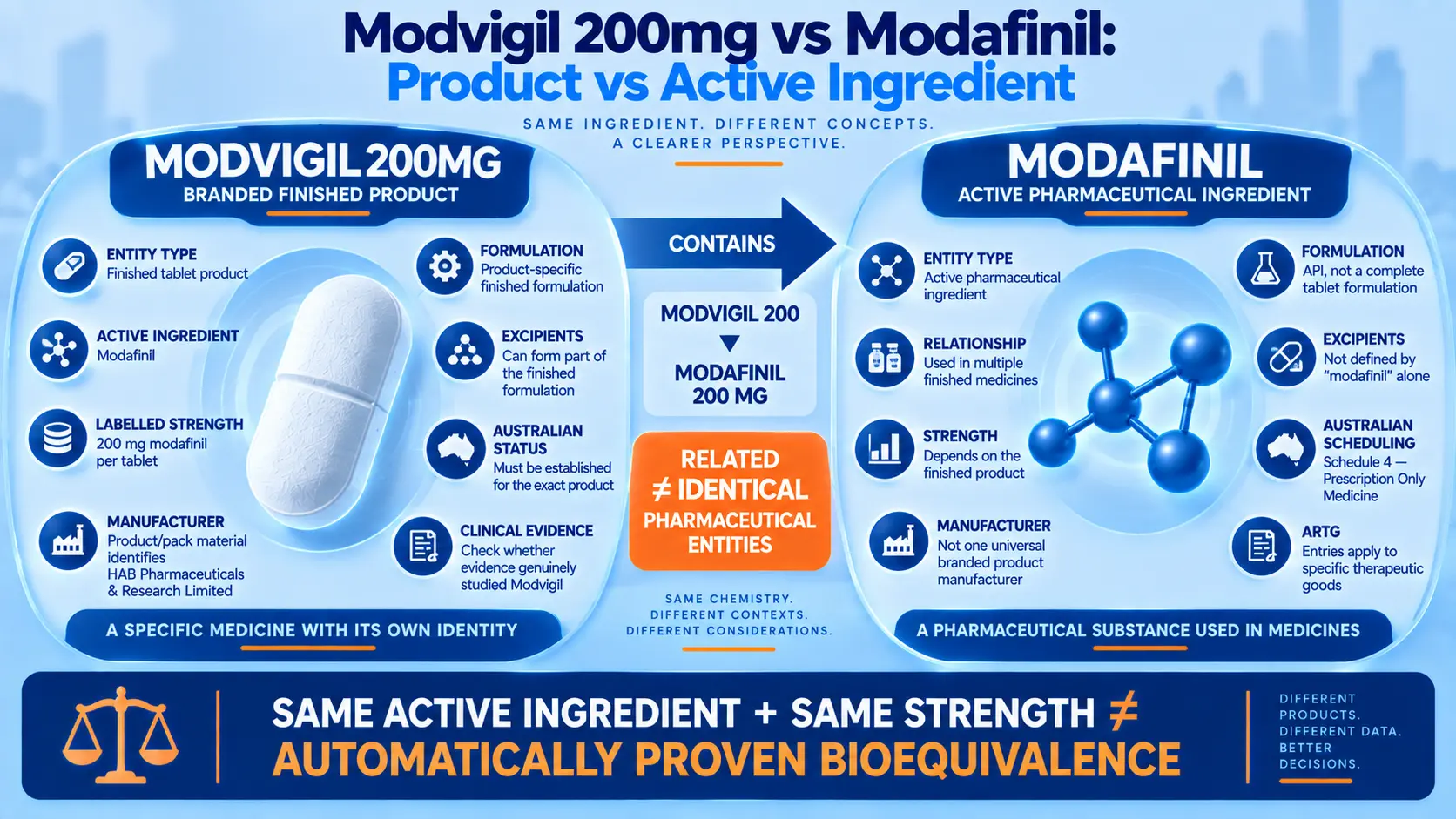
The comparison shows why modvigil 200mg vs modafinil is not a conventional medicine-versus-medicine contest. One term identifies a finished branded product; the other identifies its active ingredient.
Frequently Asked Questions
Is Modvigil 200mg the same as modafinil?
Not exactly. Modvigil 200 is a branded finished tablet product identified as containing modafinil. Modafinil is the active pharmaceutical ingredient. They are closely related, but they are not the same type of pharmaceutical entity.
Does Modvigil 200mg contain modafinil?
Yes. The product/pack material reviewed for Modvigil 200 identifies each tablet as containing modafinil USP 200 mg. This product-specific material should not be confused with Australian TGA-approved Product Information.
What is the difference between Modvigil and modafinil?
The main difference is entity type. Modvigil is a finished branded product, while modafinil is the active ingredient identified in that product.
Does 200 mg mean Modvigil contains 200 mg of modafinil?
Yes. The available Modvigil 200 product/pack information identifies 200 mg as the labelled amount of modafinil per tablet. That strength does not prove equivalence with every other medicine containing modafinil 200 mg.
Is every modafinil product the same?
No. Different finished medicines can contain the same active ingredient while having different manufacturers, formulations, excipients, packaging and regulatory records. Whether two specific medicines are bioequivalent requires appropriate evidence.
Is Modvigil registered with the TGA in Australia?
The current authoritative Australian records reviewed for this article confirm ARTG entries for other modafinil medicines, but I did not identify an authoritative current ARTG entry for the exact Modvigil product. Therefore, this article does not describe Modvigil as TGA approved or ARTG registered. This is not intended as an absolute claim that no such entry could exist.
Does the same active ingredient mean two medicines are bioequivalent?
No. Sharing an active ingredient and labelled strength does not by itself demonstrate bioequivalence. The TGA requires appropriate evidence of bioequivalence for generic prescription medicines rather than assuming it solely from ingredient identity.
Conclusion
The answer to modvigil 200mg vs modafinil starts with one essential distinction:
Modvigil 200 is a branded finished tablet product.
Modafinil is the active pharmaceutical ingredient it is identified as containing.
Product/pack information reviewed for Modvigil 200 identifies modafinil USP 200 mg per tablet and HAB Pharmaceuticals & Research Limited as the manufacturer. That establishes the product–ingredient relationship supported by the available product evidence.
However, it does not make “Modvigil” and “modafinil” interchangeable pharmaceutical entities.
A finished medicine can have its own manufacturer, formulation, excipients, presentation and regulatory history. In addition, sharing an active ingredient and labelled strength does not by itself establish bioequivalence with another finished medicine.
For Australians, the regulatory distinction is equally important. Modafinil is a Schedule 4 Prescription Only Medicine, while ARTG registration is product-specific. Modafinil’s scheduling status—or the ARTG registration of APO-MODAFINIL, MODAFINIL-WGR or another modafinil medicine—cannot automatically be transferred to Modvigil.
The clearest interpretation is therefore:
Modvigil = finished branded product.
Modafinil = active ingredient.
They are directly related, but they are not the same pharmaceutical entity.

ModvigilAUS Medical Editorial Team
ModvigilAUS Health Research Desk is the internal editorial team behind ModvigilAUS.com's educational content on Modafinil and Armodafinil. All articles are prepared using publicly available medical and scientific references, Australian regulatory guidance, and internal editorial review standards.
See all author post
10 Comments