- Your cart is empty
- Continue Shopping

Waklert and Sleep: How Armodafinil Affects Wakefulness and Sleep Timing
- Armodafinil
- Posted on
-
by ModvigilAUS Medical Editorial Team
- 0 comments
Medical Disclaimer
This article provides general educational information and does not replace advice from a qualified healthcare professional. It should not be used to self-prescribe armodafinil or independently alter prescribed treatment.
Waklert sleep effects can include insomnia and changes in sleep timing. Does Waklert affect sleep, and can it make falling asleep more difficult? Yes. Waklert is an overseas-branded medicine identified as containing armodafinil, a wakefulness-promoting medicine that may contribute to insomnia or changes in sleep timing.
Armodafinil is used to manage excessive sleepiness associated with certain diagnosed sleep disorders. However, feeling less sleepy does not mean the body’s biological need for sleep has disappeared.
The relationship between Waklert and sleep depends on individual sensitivity, circadian rhythms, underlying medical conditions and other medicines.
Clinical research has demonstrated improvements in wakefulness, although findings concerning sleep quality and disruption are less consistent.
Most evidence comes from studies involving armodafinil or Nuvigil rather than dedicated Waklert trials.
Waklert Sleep Effects: What Does the Evidence Show?
Waklert contains armodafinil, a pharmaceutical ingredient that acts on the central nervous system to promote wakefulness.
Its established therapeutic role concerns excessive sleepiness associated with particular medical conditions.
However, increased wakefulness may interfere with falling asleep or maintaining an intended sleep pattern.
When considering Waklert sleep concerns, insomnia is a recognised adverse reaction to armodafinil-containing medicines. Some individuals experience difficulty initiating sleep, while others report interrupted sleep or reduced sleep quality.
Responses vary. A person may experience improved wakefulness without substantial sleep disruption, while another may notice unwanted alertness during an intended rest period.
Importantly, armodafinil does not eliminate the biological requirement for sleep.
Feeling more awake and obtaining sufficient restorative sleep are different outcomes.
This distinction matters because normal sleep regulation continues operating even when medication reduces perceived sleepiness.
How Does Armodafinil Promote Wakefulness?
Armodafinil is the R-enantiomer of modafinil. An enantiomer is one of two mirror-image molecular forms of a substance.
Armodafinil influences neurological processes involved in maintaining wakefulness, although researchers have not fully established its precise mechanism.
Laboratory evidence indicates that armodafinil interacts with dopamine transporters and inhibits dopamine reuptake.
Dopamine is a neurotransmitter involved in several functions, including movement, motivation and aspects of alertness.
However, dopamine transporter activity does not explain every effect of armodafinil on sleep and wakefulness.
Other neurological systems may contribute.
Australian Prescriber’s review of armodafinil also identifies uncertainty about its precise mechanism.
Armodafinil should therefore not be understood as simply switching off the brain’s sleep-regulating systems. It promotes wakefulness while underlying sleep-regulatory processes continue functioning.
Understanding the Sleep-Wake Cycle
Understanding Waklert sleep effects starts with the fact that normal sleep and wakefulness depend on several interacting biological processes.
Two especially important systems are circadian timing and sleep homeostasis.
Circadian Rhythm and Sleep Timing
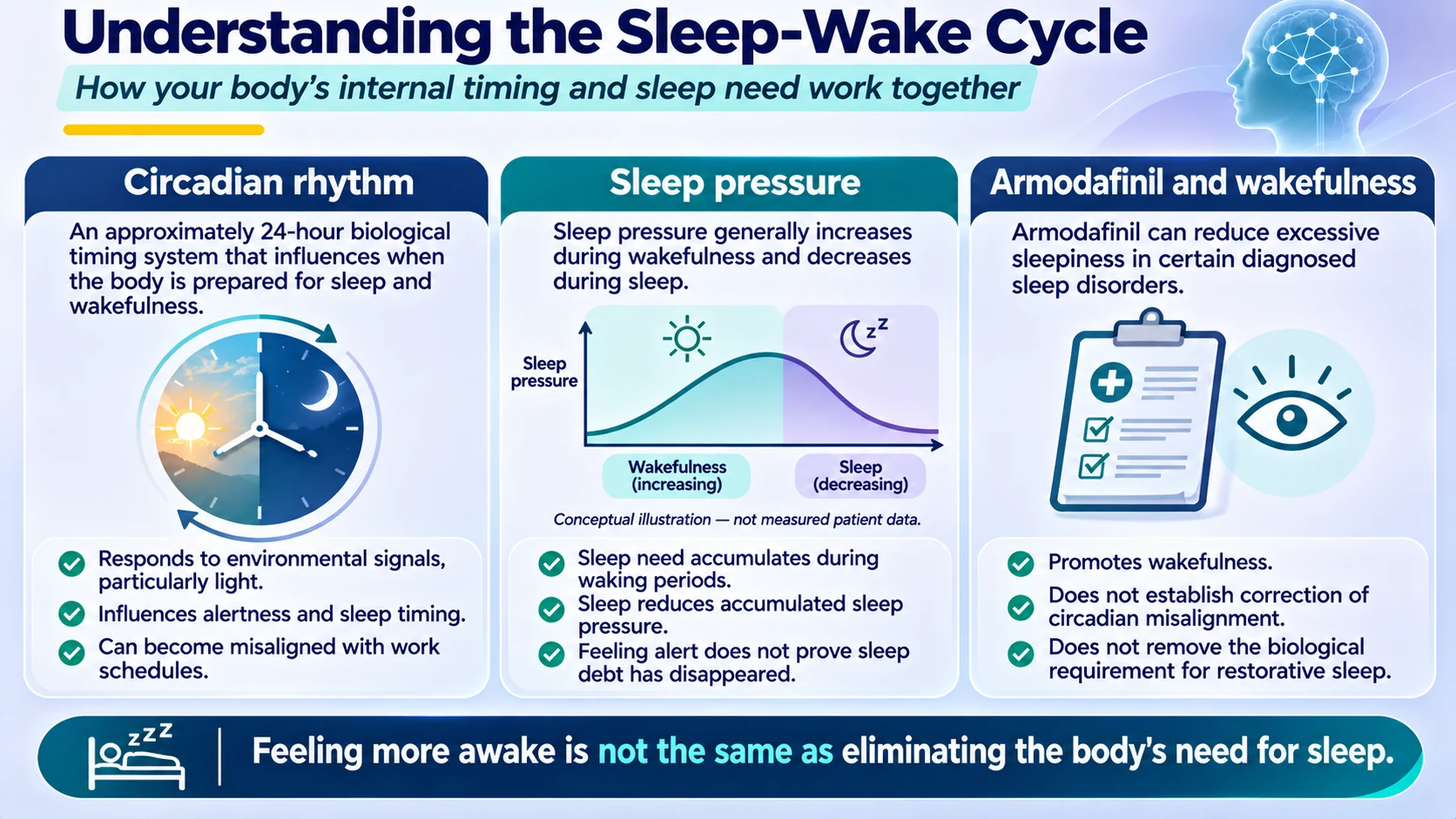
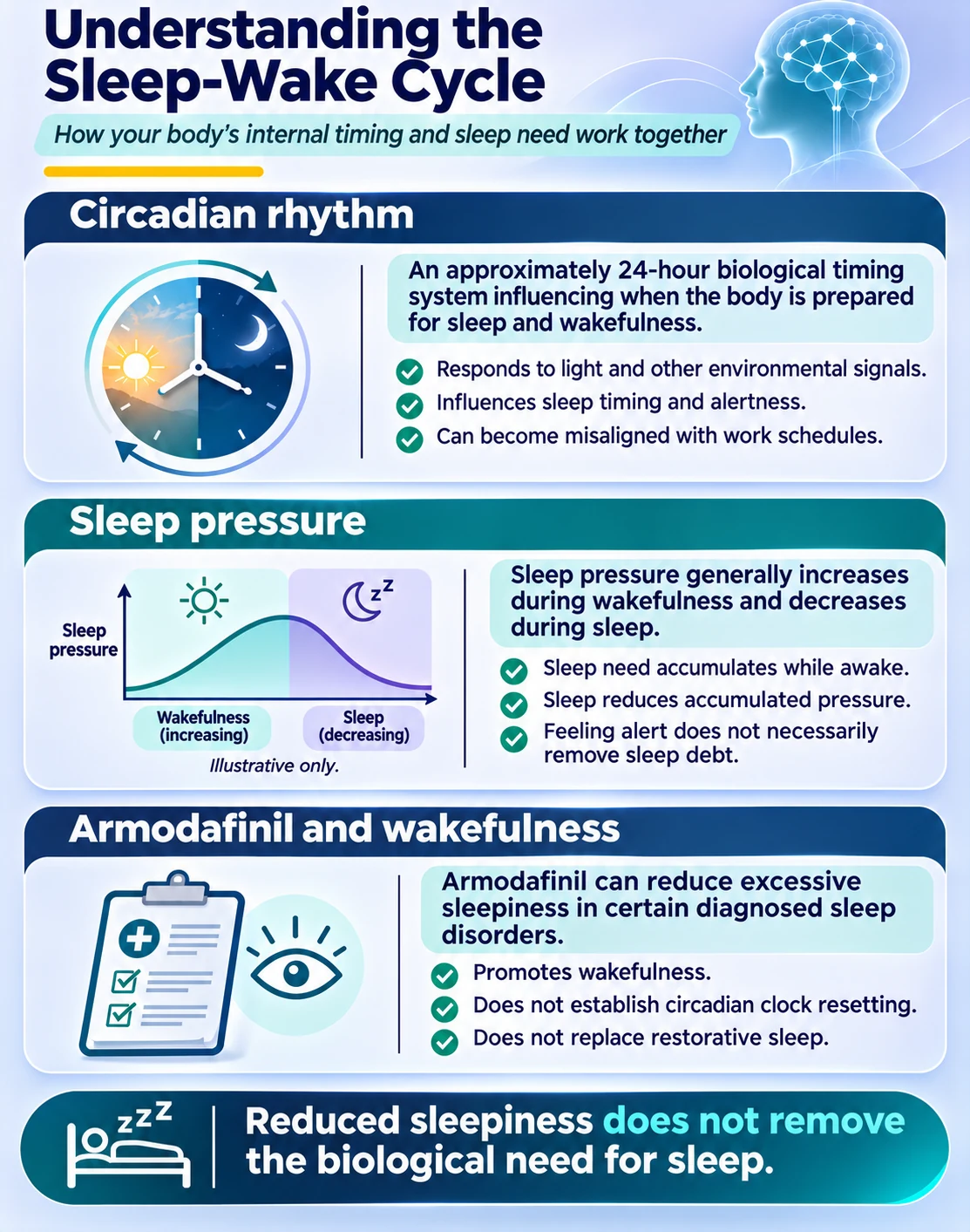
The circadian rhythm is an approximately 24-hour biological timing system that influences when the body is prepared for sleep and wakefulness.
The brain’s central circadian clock responds to environmental signals, particularly light, and helps coordinate daily physiological rhythms.
These rhythms influence alertness, body temperature, hormone release and the tendency to sleep.
Circadian timing can become misaligned with work or social schedules.
For example, someone working overnight may experience strong sleepiness because their internal clock is promoting sleep.
Armodafinil can improve wakefulness in appropriately diagnosed shift work sleep disorder. However, this does not establish that it resets the body’s circadian clock.
Promoting wakefulness is not the same as correcting circadian misalignment.
Sleep Pressure and Homeostasis
Sleep homeostasis describes how the body regulates its need for sleep.
Sleep pressure generally increases during wakefulness and decreases during sleep.
This process works alongside circadian timing.
Someone may accumulate substantial sleep pressure during prolonged wakefulness, even when environmental factors or medication temporarily make them feel more alert.
Wakefulness-promoting treatment may reduce perceived sleepiness without resolving that accumulated sleep need.
Consequently, feeling awake after armodafinil should not be interpreted as proof that the body no longer requires restorative sleep.
Wakefulness-Promoting Medicines and Normal Sleep Regulation
Armodafinil manages excessive sleepiness but does not necessarily treat the underlying condition responsible for it.
In obstructive sleep apnoea, repeated upper-airway obstruction can disrupt breathing and sleep continuity.
Armodafinil does not correct that airway obstruction.
Similarly, improving alertness during shift work does not necessarily restore normal circadian alignment.
Therefore, wakefulness treatment and healthy sleep regulation must be considered separately.
Can Waklert Cause Insomnia?
Yes. Waklert sleep complaints may include insomnia, a recognised possible adverse reaction to armodafinil.
Insomnia can involve difficulty falling asleep, waking repeatedly during an intended rest period or experiencing unsatisfactory sleep.
Sleep onset latency describes the time between attempting to sleep and actually falling asleep.
Sleep maintenance concerns the ability to remain asleep without unwanted awakenings.
A person may also report poor sleep quality without a measurable reduction in total sleep duration.
These experiences are related but not identical.
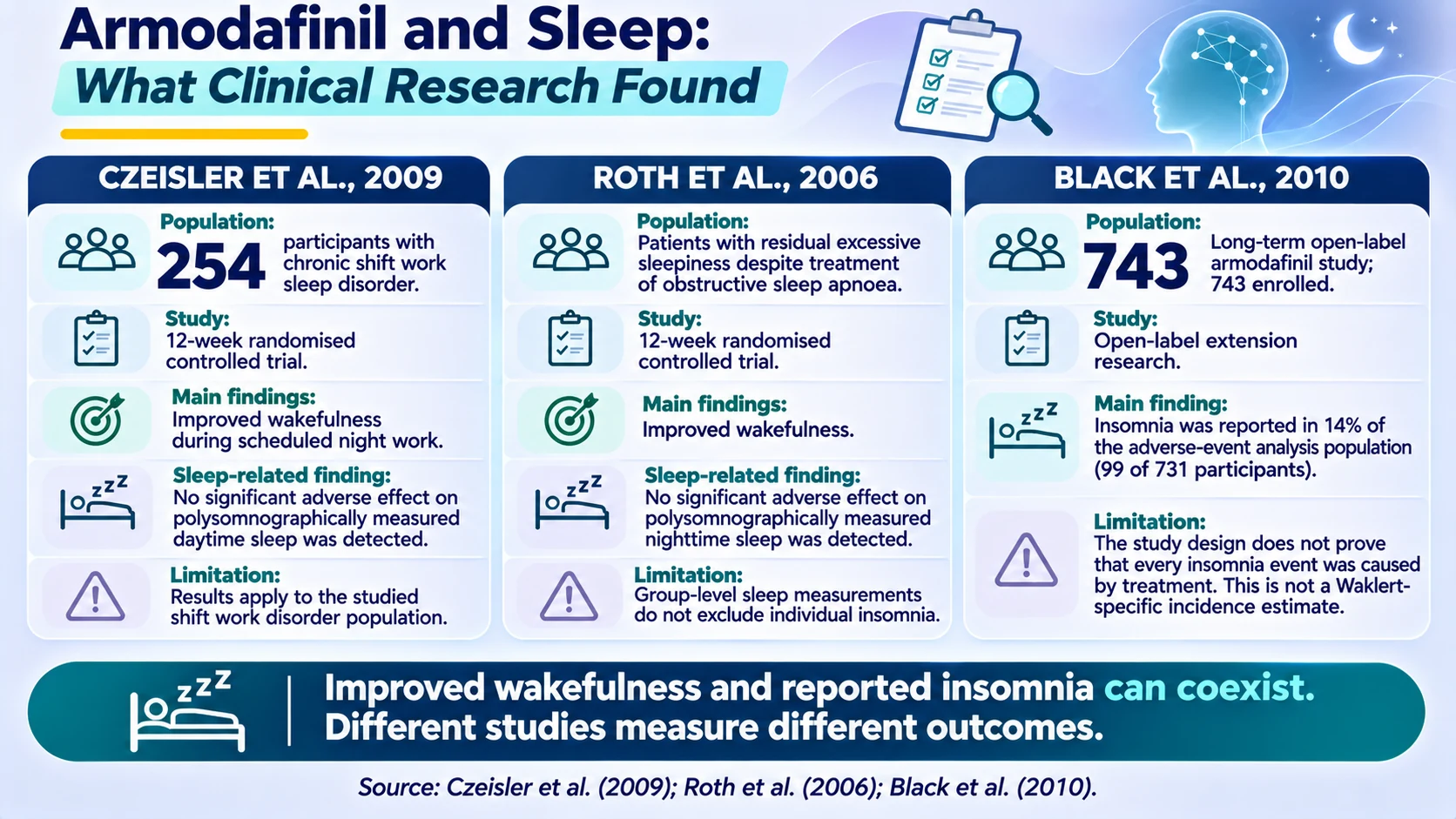
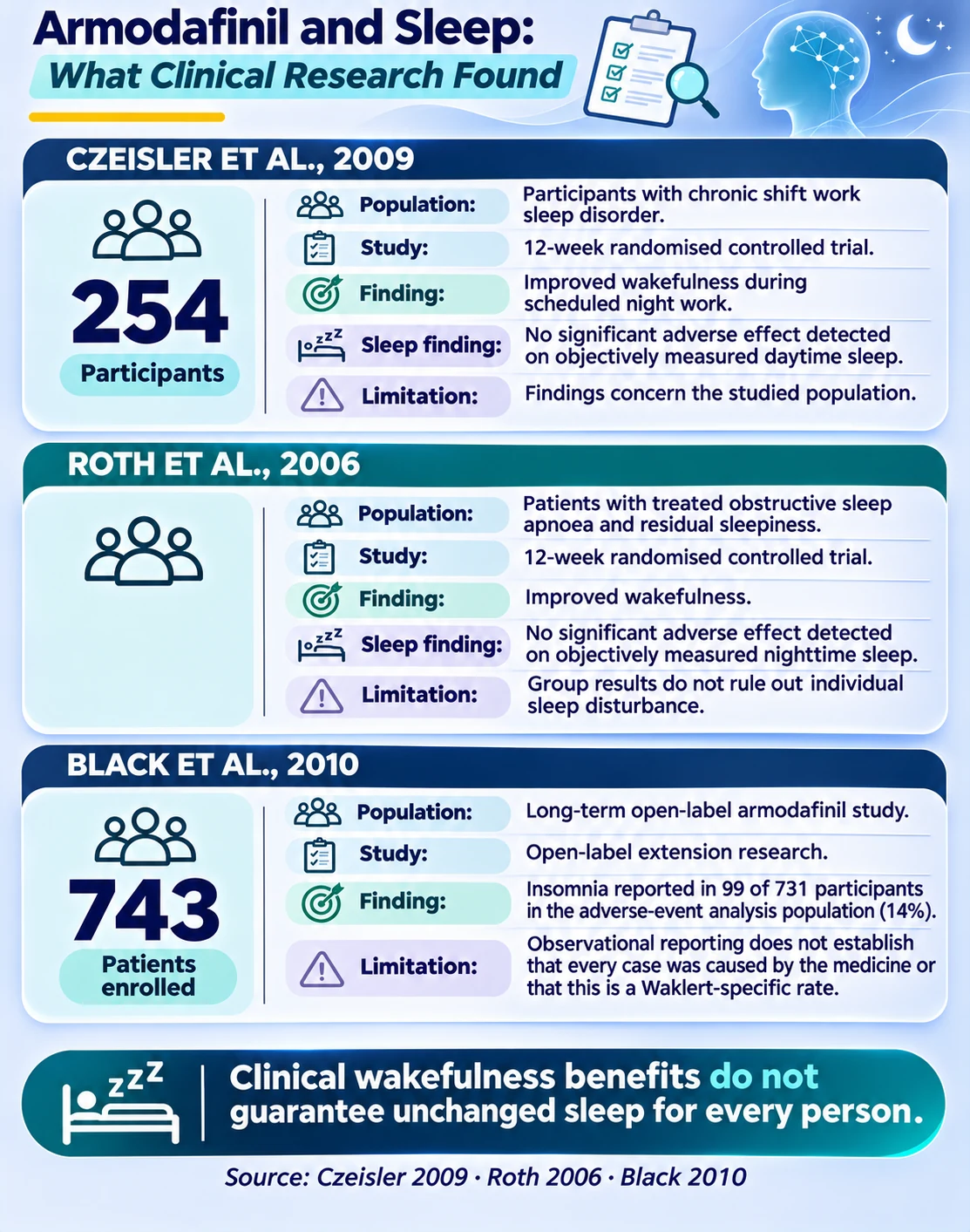
A 2010 long-term open-label study by Black and colleagues reported insomnia in 14% of participants in its adverse-event analysis population (99 of 731).
The wider study enrolled 743 patients. The 14% figure applies specifically to the 731 participants included in that safety analysis.
Because the study was open-label and lacked a long-term placebo comparison, it cannot establish that every reported insomnia event was caused by armodafinil.
Furthermore, this is an armodafinil study finding, not a Waklert-specific insomnia rate.
Individual health, sleep patterns and concurrent medicines can influence sleep-related symptoms.
How Can Armodafinil Influence Sleep Timing?
Armodafinil may influence the relationship between intended bedtime and the ability to fall asleep.
One contributing factor is residual medicine exposure.
Armodafinil remains in the body after its strongest noticeable wakefulness effects have diminished.
Consequently, someone may no longer feel particularly alert while measurable medicine remains in the bloodstream.
Residual exposure may contribute to sleep difficulties in susceptible individuals. However, it cannot reliably predict exactly when sleep disturbance will occur.
Circadian timing is another consideration.
The body’s biological tendency to sleep changes throughout the day and night. An intended sleep period may not coincide with the strongest circadian sleep signal.
This is particularly relevant to shift work sleep disorder.
Underlying medical conditions, other medicines and individual sensitivity may further influence sleep timing.
There is no universal period during which armodafinil will cause sleep disruption in every person.
Sleep-related changes should therefore be interpreted in their clinical context.
Does Waklert Change Sleep Duration or Sleep Quality?
For Waklert sleep questions, research provides stronger evidence for armodafinil’s wakefulness effects than for consistent changes in sleep duration or quality.
These outcomes measure different aspects of sleep.
- Sleep duration: Total time spent asleep.
- Sleep onset latency: Time required to fall asleep.
- Sleep continuity: Whether sleep remains uninterrupted or includes awakenings.
- Subjective sleep quality: How well someone believes they slept.
- Polysomnography: A laboratory method for measuring sleep using physiological recordings.
A person may report poor sleep quality despite sleeping for a relatively normal duration.
A 12-week randomised trial by Roth and colleagues examined armodafinil in patients with residual sleepiness despite treatment of obstructive sleep apnoea.
Researchers reported improved wakefulness without a statistically significant adverse effect on polysomnographically measured nighttime sleep.
Similarly, a controlled shift work sleep disorder trial found improved wakefulness without adverse changes in measured daytime sleep.
These results do not contradict insomnia reports.
Group-level findings may not capture every individual sleep complaint. Furthermore, the absence of significant deterioration does not demonstrate improved sleep quality.
There is insufficient Waklert-specific evidence to establish consistent changes in sleep duration or quality.
What Does Clinical Research Say About Armodafinil and Sleep?
Evidence in Narcolepsy
Narcolepsy is a neurological disorder associated with excessive daytime sleepiness and difficulty maintaining stable wakefulness.
A 12-week randomised, double-blind study by Harsh and colleagues involved 196 adults with narcolepsy.
Researchers reported improvements in objective wakefulness and subjective sleepiness compared with placebo.
The study used the Maintenance of Wakefulness Test, which evaluates the ability to remain awake under controlled conditions.
However, better daytime wakefulness does not necessarily demonstrate improved nighttime sleep quality or resolution of the underlying disorder.
Evidence in Treated Obstructive Sleep Apnoea
Obstructive sleep apnoea involves repeated narrowing or obstruction of the upper airway during sleep.
Some patients continue experiencing excessive sleepiness despite effective treatment with continuous positive airway pressure.
The Roth trial evaluated armodafinil as an additional treatment for residual sleepiness in this selected population.
Researchers reported improved wakefulness without statistically significant worsening of measured nighttime sleep.
However, armodafinil does not correct airway obstruction or replace established obstructive sleep apnoea treatment.
Evidence in Shift Work Sleep Disorder
Shift work sleep disorder can occur when required working hours conflict with the body’s biological sleep timing.
A 2009 randomised study by Czeisler and colleagues enrolled 254 people with chronic shift work sleep disorder.
Over 12 weeks, armodafinil improved wakefulness during scheduled night work compared with placebo.
Researchers also recorded reductions in subjective sleepiness.
Importantly, the study did not find an adverse effect on daytime sleep measured through polysomnography.
However, these findings do not demonstrate that armodafinil resets circadian rhythms or removes the need for adequate sleep.
Limitations of Clinical Evidence
Evidence about Waklert sleep effects must be interpreted carefully. Most pivotal armodafinil trials involved selected adults with diagnosed sleep disorders and lasted approximately 12 weeks.
Longer observational studies contribute useful safety information but generally have fewer safeguards against selection and reporting bias.
Studies also assess different outcomes, including objective wakefulness, subjective sleepiness and sleep architecture.
An improvement in one measurement does not establish an improvement in every other aspect of sleep.
Additionally, clinical evidence from Nuvigil or research formulations does not independently prove that Waklert has identical therapeutic performance or bioequivalence.
Can Waklert Replace Adequate Sleep?
For a related explanation of medicine duration and residual alertness, see How Long Does Waklert Last?.
No. Armodafinil promotes wakefulness but cannot replace the physiological functions of normal sleep.
Restorative sleep contributes to memory consolidation, metabolic regulation and overall physical and mental health.
Reducing perceived sleepiness does not reproduce these processes.
Likewise, greater alertness does not establish that accumulated sleep debt has been resolved.
Armodafinil may be prescribed for specific disorders involving excessive sleepiness, but it is not a replacement for adequate sleep or appropriate management of an underlying sleep disorder.
What Factors May Influence Waklert-Related Sleep Disturbance?
Sleep disruption during armodafinil treatment may involve several contributing factors.
Existing insomnia: Symptoms that were present before treatment can complicate assessment of medicine-related sleep disturbance.
Underlying sleep disorders: Narcolepsy, obstructive sleep apnoea and shift work sleep disorder may independently affect sleep quality and timing.
Circadian differences: Individuals naturally differ in their preferred sleep and wake schedules.
Concurrent medicines: Other treatments may influence alertness, sleep quality or medication interactions.
Stress and environment: Anxiety, irregular schedules, noise and unsuitable sleeping environments can contribute to sleep disruption.
These factors demonstrate why every sleep problem during treatment should not automatically be attributed to Waklert.
Clinical assessment helps identify possible causes and appropriate management.
Australian Prescription and Safety Considerations
Armodafinil is classified as a Schedule 4 prescription-only medicine under Australia’s October 2026 Poisons Standard.
Nuvigil is a specific armodafinil medicine registered in Australia. The TGA records Nuvigil 150mg under ARTG number 226559, with active status.
Waklert is a separately branded overseas medicine. Nuvigil’s registration does not establish Waklert’s Australian approval or bioequivalence.
Australian Nuvigil medical information identifies insomnia and precautions concerning psychiatric symptoms, cardiovascular conditions, serious hypersensitivity reactions and medicine interactions.
The TGA has also documented pregnancy-related Product Information changes in 2025 and an ioflupane interaction update in 2026.
Persistent insomnia or changes in sleep functioning during prescribed treatment warrant assessment by the prescribing clinician.
Australian law also generally restricts public advertising of prescription medicines.
Educational content discussing a named prescription medicine on a commercial website must be assessed in its full advertising context.
Frequently Asked Questions
Does Waklert affect sleep at night?
Can Waklert cause insomnia?
Does armodafinil reduce the need for sleep?
Can Waklert change sleep timing?
Does Waklert improve sleep quality?
What should patients discuss with their doctor if sleep problems occur?
Conclusion
Waklert sleep effects reflect a distinction between promoting wakefulness and meeting the body’s continuing need for restorative sleep. Armodafinil can cause insomnia in some people, while selected trials have not shown significant worsening of measured sleep at the group level. Australian readers should distinguish armodafinil evidence from Waklert-specific regulatory and clinical claims.

ModvigilAUS Medical Editorial Team
ModvigilAUS Health Research Desk is the internal editorial team behind ModvigilAUS.com's educational content on Modafinil and Armodafinil. All articles are prepared using publicly available medical and scientific references, Australian regulatory guidance, and internal editorial review standards.
See all author post